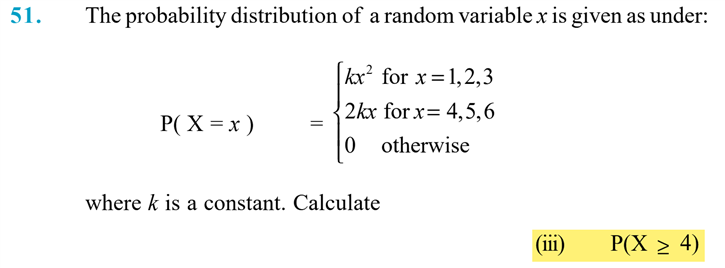
The probability distribution of a random variable X is given under:
\(P(X=x)=\begin{cases}kx^2, & \text{for } x=1, 2, 3\\ 2kx, & \text{for } x=4, 5, 6\\ 0, & \text{otherwise}\end{cases}\)
Then \(P(X \ge 4)\) is:
Answer & explanation
Correct answer: option 4
The correct answer is Option (4) → \(\displaystyle\frac{15}{22}\)
In a probability distribution the probabilities add up to 1:
\( k(1^2+2^2+3^2)+2k(4+5+6)=1 \)
\( 14k+30k=1 \)
\( \displaystyle 44k=1,\quad k=\frac{1}{44} \)
X ≥ 4 means X = 4, 5 or 6:
\( P(X\ge 4)=2k(4+5+6)=30k \)
\( \displaystyle =\frac{30}{44}=\frac{15}{22} \)
NCERT Exemplar:
Probability