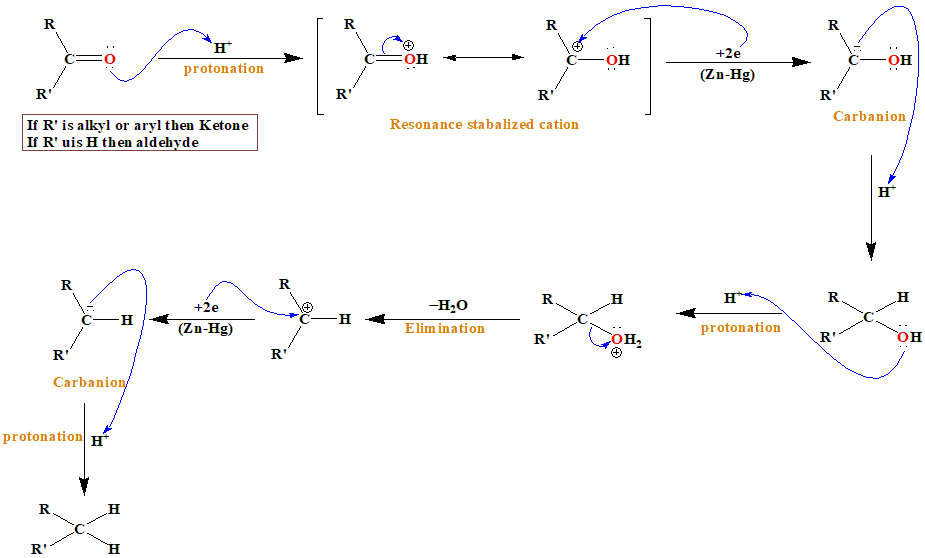
In Clemensen reduction the reagents are:
A. \(Zn-Hg\)
B. \(HCl\)
C. \(Zn\)
D. \(H_2SO_4\)
E. \(Cu\)
Choose the correct answer from the options given below:
Answer & explanation
Correct answer: option 4
The correct answer is option 4. A and B only.
The Clemmensen reduction allows the conversion of a carbonyl group to the corresponding methylene group using zinc amalgam \((Zn-Hg)\) and concentrated hydrochloric acid \((HCl)\).
General features:
1. Due to the harsh conditions of the Clemmensen reduction, acid-sensitive substrates and polyfunctional ketones rarely deliver the expected alkanes.
2. Milder procedures have been developed to make the synthesis appropriate for acid- and heat-sensitive compounds (e.g., organic solvents saturated with dry HCl and activated zinc dust at ice-bath temperature).
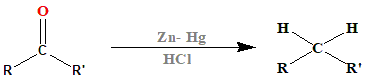
Mechanism:
In this reaction mineral acid supplies proton to oxygen, whereas metal Zn supplies an electron pair to electron deficient carbonyl carbon to form carbanion. This mechanism involves three steps namely (i) formation of carbanion, (ii) elimination of water, and (iii) addition of proton.