
In a triangle ABC, D and E are points on BC such that AD = AE and ∠BAD = ∠CAE. IF AB = (2p +3), BD = 2p, AC = (3q -1) and CE = q, then find the value of (p+q).
Answer & explanation
Correct answer: option 1
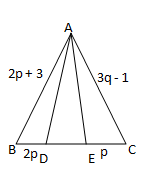
In \(\Delta \)ABD and \(\Delta \)AEC,
AD = AE [Given]
\(\angle\)ADB = \(\angle\)AEC [Exterior angles of ADE, where \(\angle\)ADE = \(\angle\)AED]
\(\angle\)BAD = \(\angle\)CAE [Given]
So, \(\Delta \)ABD \(similar\) \(\Delta \)AEC
Then,
= \(\frac{AB}{AC}\) = \(\frac{BD}{CE}\) = \(\frac{AD}{AE}\)
= \(\frac{2p\;+\;3}{3q\;-\;1}\) = \(\frac{2q}{q}\) = 1 [as AD = AE]
By taking \(\frac{2q}{q}\) = 1
= 2p = q ..(1)
By taking \(\frac{2p\;+\;3}{3q\;-\;1}\) = 1
= 2p + 3 = 3q - 1
= 3q - 2p = 3 + 1
= 3q - q = 4 [as 2p = q]
= 2q = 4
= q = \(\frac{4}{2}\) = 2
Put q = 2 in equation (1),
2p = 2
= p = 1
Then, (p + q) = 1 + 2 = 3
Therefore, (p+q) = 3