
Which of the following compound will not undergo Azo coupling reaction?
Answer & explanation
Correct answer: option 4
The correct answer is Option (4) → Nitrobenzene
In azo coupling the benzene diazonium ion acts as an electrophile and attacks another aromatic ring, usually at the para position, joining the two rings through –N=N–. The diazonium ion is a weak electrophile, so it can attack only a ring made electron-rich by a strongly activating group such as –OH, –\( \ce{NH2} \) or –\( \ce{OCH3} \).
Option (1) Aniline — Undergoes coupling. The –\( \ce{NH2} \) group strongly activates the ring, and coupling in mildly acidic solution gives yellow p-aminoazobenzene.
\( \displaystyle \ce{C6H5N2^+Cl^- + C6H5NH2} \xrightarrow{\ce{H+}} p\text{-}\ce{H2N-C6H4-N=N-C6H5 + HCl} \)
Option (2) Phenol — Undergoes coupling. Phenol couples readily in mildly alkaline solution, where the phenoxide ion is even more strongly activated, giving orange p-hydroxyazobenzene.
\( \displaystyle \ce{C6H5N2^+Cl^- + C6H5OH} \xrightarrow{\ce{OH-}} p\text{-}\ce{HO-C6H4-N=N-C6H5 + HCl} \)
Option (3) Anisole — Undergoes coupling (activated ring). The –\( \ce{OCH3} \) group activates the ring by resonance and directs to the para position, so anisole couples to give p-methoxyazobenzene, though more slowly than phenol.
Option (4) Nitrobenzene — Does not undergo coupling (deactivated ring). The –\( \ce{NO2} \) group withdraws electrons from the ring by both inductive and resonance effects and deactivates it, so the weak diazonium electrophile cannot attack it.
NCERT (2026-27 edition):
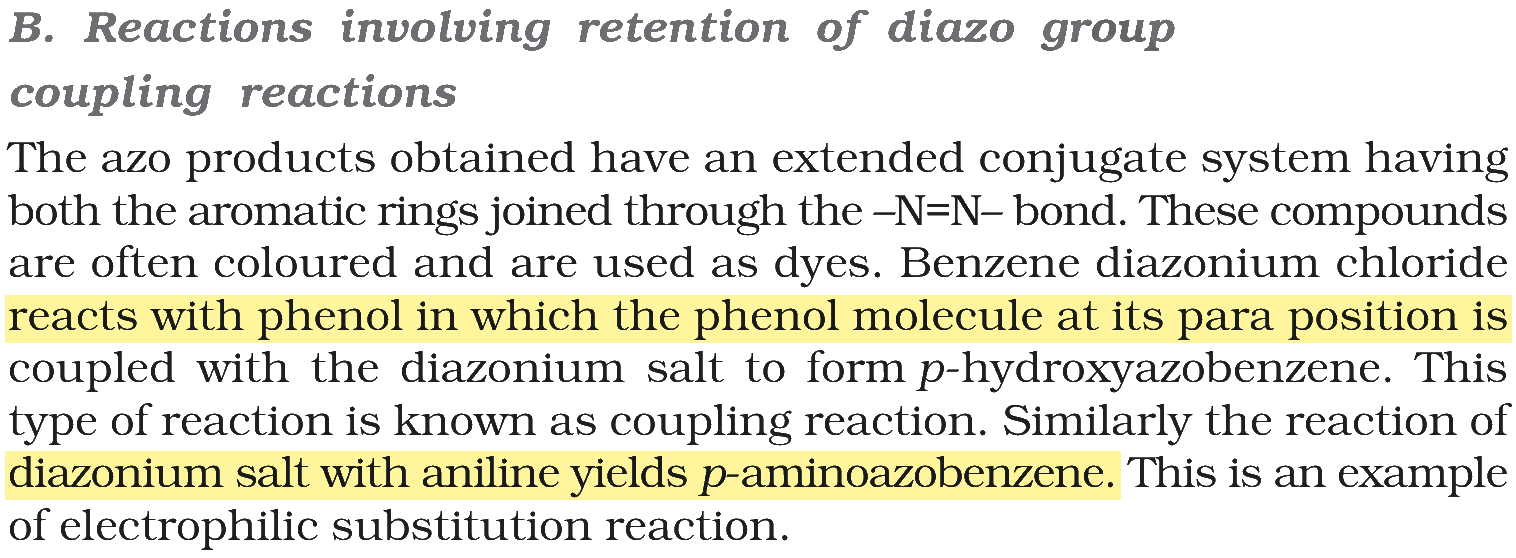
Reactions Involving Retention of Diazo Group
Note: The same/similar question has been asked in different years by NTA as per the details given below:
| 2026 | 2025 | 2024 | 2023 | 2022 |
|---|---|---|---|---|
| – | 23-05 S2 13-05 S1 | – | 15-06 S1 31-05 S2 | – |