CUETMOCK
  • Pricing
  • Mentors
Log inStart freeStart free mocks→

First test, then trust

Try a free CUET mock test.

Join 5,00,000+ students who rehearsed exam day on the exact NTA screen before sitting CUET. On the web and on Android.

Start free mocks →Get the Android app
CUETMOCK

India's #1 CUET Mock Test Platform. Original NCERT-based questions on the exact NTA exam screen — trusted by 5,00,000+ students since CUET 2022.

Get it onGoogle PlayScan to download the CUETMOCK app

Mock tests

  • CUET mock test series
  • Browse all papers
  • Commerce mocks
  • Humanities (Arts) mocks
  • Science mocks
  • Languages & GAT mocks
  • Free practice questions
  • Pricing

Resources

  • CUET exam guide
  • CUET syllabus
  • Universities accepting CUET
  • Expert blogs
  • News & notifications
  • Webinars & counselling
  • CUET score calculator
  • How we estimate your rank
  • FAQs

Company

  • About us
  • Our leadership & team
  • Our toppers
  • Mentors
  • For schools
  • Contact us
  • Terms
  • Privacy
  • Refund policy

Talk to us

+91 7696 6630 56info@cuetmock.comWhatsApp us

Our other platforms

  • JEE Mock — For IIT-JEE aspirants
  • NEET Mock — For NEET aspirants

Newsletter

Exam updates, study material and offers — no spam.

© 2026 NYC Ventures Pvt. Ltd.

701-702, Royal Business Park, Zirakpur, Punjab - 140603

  • Terms of use
  • Privacy policy
  • Refund policy
  • Contact us

iCUETMOCK is an independent preparation platform, not affiliated with the National Testing Agency (NTA). Always check exam details on the official NTA website.

  • Home
  • Mock tests
  • CUET guide
  • Pricing
  • Log in
Home/Practice questions/Economics
EconomicsMacro Economics: Open Economy Macro Economics

(A) Floating exchange rate is determined by supply and demand of Doll…

(A) Floating exchange rate is determined by supply and demand of Dollar only.

(B) Floating exchange rate is determined by supply of the particular currency.

(C) Floating exchange rate is determined by the total stock of gold reserve.

(D) Floating exchange rate is determined by the demand for the particular currency.

(E) Floating exchange rate is determined by the relative supply and demand of the currencies.

Choose the correct answer from the options given below :

Answer & explanation+

Correct answer: option 2

The correct answer is Option (2) → (E) Only

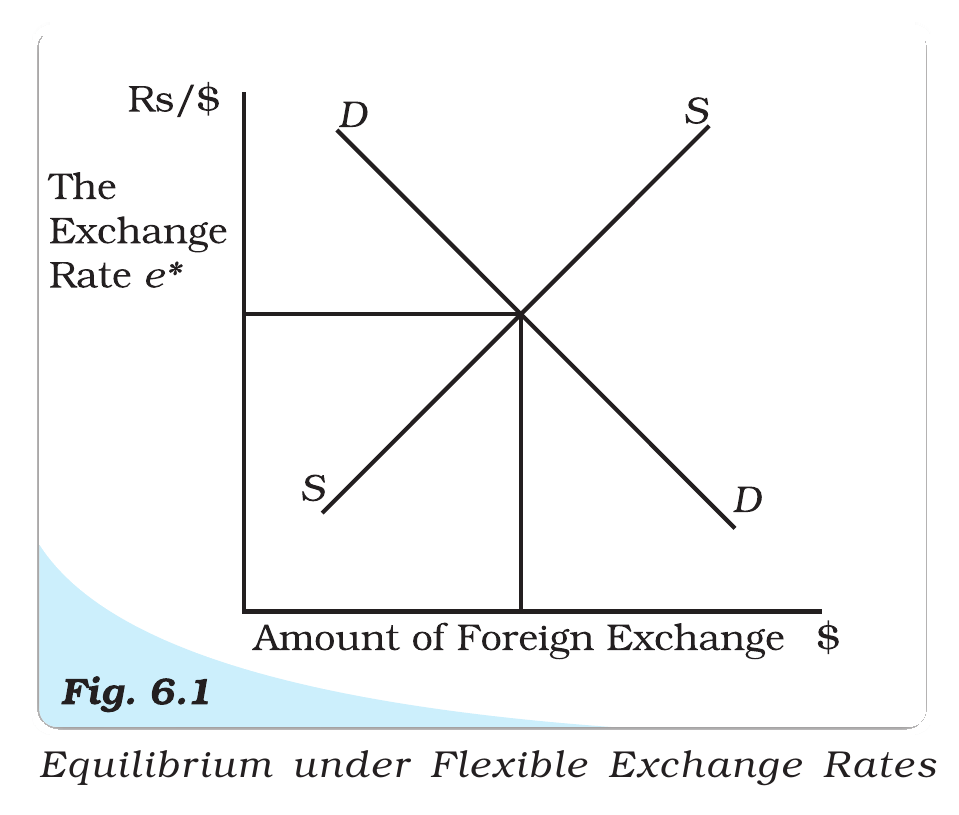
A floating (flexible) exchange rate is set by the market forces of demand and supply. The rupee price of the dollar settles where the demand for dollars equals their supply.

(A) Floating exchange rate is determined by supply and demand of Dollar only. — False. The rate between any two currencies is set in their own market. The rupee–yen rate, for example, does not depend on the dollar alone.

(B) Floating exchange rate is determined by supply of the particular currency. — False. Supply alone cannot fix a price. The rate changes when demand changes too, as when more travel abroad raises the demand for foreign currency.

(C) Floating exchange rate is determined by the total stock of gold reserve. — False. A link with gold belonged to the gold standard, a fixed exchange rate system. A floating rate has no such link.

(D) Floating exchange rate is determined by the demand for the particular currency. — False. Demand alone is half the story. The rate rises only when demand grows faster than supply.

(E) Floating exchange rate is determined by the relative supply and demand of the currencies. — True. The rate moves with both demand and supply, and settles where they are equal.

NCERT (2026-27): “6.2.2 Determination of the Exchange Rate Different countries have different methods of determining their currency’s exchange rate. It can be determined through Flexible Exchange Rate, Fixed Exchange Rate or Managed Floating Exchange Rate.

Flexible Exchange Rate This exchange rate is determined by the market forces of demand and supply. It is also known as Floating Exchange Rate. As depicted in Fig. 6.1, the exchange rate is determined where the demand curve intersects with the supply curve, i.e., at point e on the Y – axis. Point q on the x – axis determines the quantity of US Dollars that have been demanded and supplied on e exchange rate. In a completely flexible system, the Central banks do not intervene in the foreign exchange market.…”

NCERT extract

Advertisement

Practise more on Macro Economics: Open Economy Macro Economics

Chapter-wise mocks on the real NTA exam screen, with solutions and your rank. Your first mocks are free.

Start free mocks →

Advertisement

Next questions

  1. Which Magadha ruler murdered his father to ascend the throne and in turn was murdered by his own son?General Aptitude Test · General Knowledge
  2. Match List - I with List - II. LIST-I(Tribal Concepts)LIST-II(Characteristics)(A)Dalit Sangharsh Samiti(I)Tribes(B)Sachar Committee(II)Matr…Sociology · Indian Society: Patterns of Social Inequality and Exclusion
  3. In a certain code language, '471' means 'Hair is White', '726' means 'White Her Cow', and '639' means 'Cow gives Milk'. What is the code fo…General Aptitude Test · Verbal Reasoning
  4. Select the answer figure in which the question figure is hidden?General Aptitude Test · Verbal Reasoning
  5. शुद्ध वाक्य बनाने हेतु क्रम व्यवस्थित कीजिए -A. परंतु वर्षा न होने सेB. किसान ने खेत मेंC. फसल अच्छी नहीं हुईD. समय पर बीज बोएनीचे दिए गए व…Hindi · वाक्य रचना (शब्दों / वाक्यांशों का क्रम)
  6. Select the option that is related to the third word in the same way as the second word is related to the first word. Night Blindness : Vita…General Aptitude Test · General Ability
  7. The liquidity and solvency of a company are measured by : (A) Current ratio(B) Profitability ratio(C) Inventory Turnover ratio(D) Debt Equi…Accountancy Part B · Accounting Ratios
  8. Which among the following genes control α-Thalassemia ?Biology · Principles of Inheritance and Variation
  9. Which of the following Airport of India has become first airport in India in June 2022 to run entirely on hydro and solar power ?General Aptitude Test · Current Affairs
  10. Three of the following match Ibn Battuta's description of the rampart round Delhi. Which one is the odd one out?History · Medieval India: Through the Eyes of Travellers