
Select the correct expression for the "parts per million" concentration term:
Answer & explanation
Correct answer: option 1
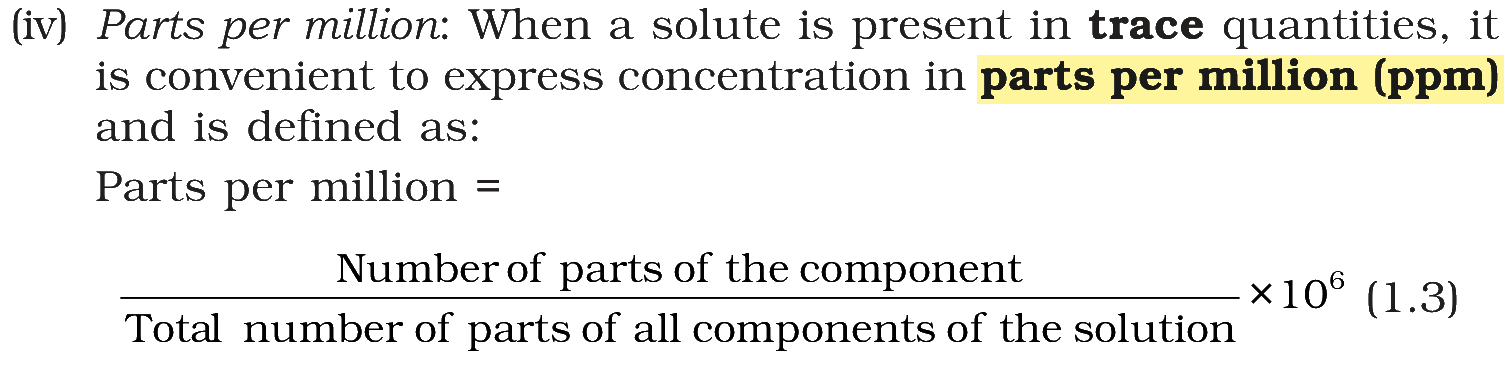
The correct answer is Option (1) → \( \text{ppm} =\frac{\text{Number of parts of the component}}{\text{Total number of parts of all components of the solution}}×10^6 \)
When a solute is present in trace quantities, its fraction is a very small number, so it is multiplied by a large factor to give a convenient value. The fraction of the component (by mass, by volume or in moles) is the same in each case; only the factor changes:
fraction × 100 = percentage (parts per hundred)
fraction × 106 = parts per million (ppm)
For example, sea water containing 5.8 g of dissolved oxygen in 106 g has 5.8 ppm of oxygen.
Why the other options are incorrect
Option (2) \( \text{ppm} =\frac{\text{Number of parts of the component}}{\text{Total number of parts of all components of the solution}}×10^3 \) — Incorrect. Multiplying by 103 gives parts per thousand.
Option (3) \( \text{ppm} =\frac{\text{Number of parts of the component}}{\text{Total number of parts of all components of the solution}}×10^{12} \) — Incorrect. Multiplying by 1012 gives parts per trillion, not per million.
Option (4) \( \text{ppm} =\frac{\text{Total number of parts of all components of the solution}}{\text{Number of parts of the component}}×10^6 \) — Incorrect. The fraction is upside down. A concentration term is the component’s share of the whole, so the parts of the component go in the numerator and the total parts in the denominator.
NCERT (2026-27 edition):
Parts per Million
Note: The same/similar question has been asked in different years by NTA as per the details given below:
| 2026 | 2025 | 2024 | 2023 | 2022 |
|---|---|---|---|---|
| – | 03-06 S2 02-06 S1 29-05 S1 | – | – | – |