Match List-I with List-II.
| List-I | List-II |
| (A) Autonomous items | (I) Net of visible trade |
| (B) Accommodating items | (II) Above the line items |
| (C) Balance of trade | (III) Portfolio investment |
| (D) Capital account | (IV) Below the line items |
Choose the correct answer from the options given below:
Answer & explanation
Correct answer: option 2
The correct answer is Option (2) → (A)-(II), (B)-(IV), (C)-(I), (D)-(III)
The balance of payments (BoP) records a country’s dealings with the rest of the world. Its items can be grouped by why a transaction takes place and by which account holds it.
| List-I | List-II | Reason |
|---|---|---|
| (A) Autonomous items | (II) Above the line items | These transactions are made for a reason of their own, such as profit, and are independent of the state of the BoP. |
| (B) Accommodating items | (IV) Below the line items | These transactions are made to bridge the gap in the BoP, as official reserve transactions are. |
| (C) Balance of trade | (I) Net of visible trade | It is the difference between the value of exports and imports of goods. Goods are the visible part of trade. |
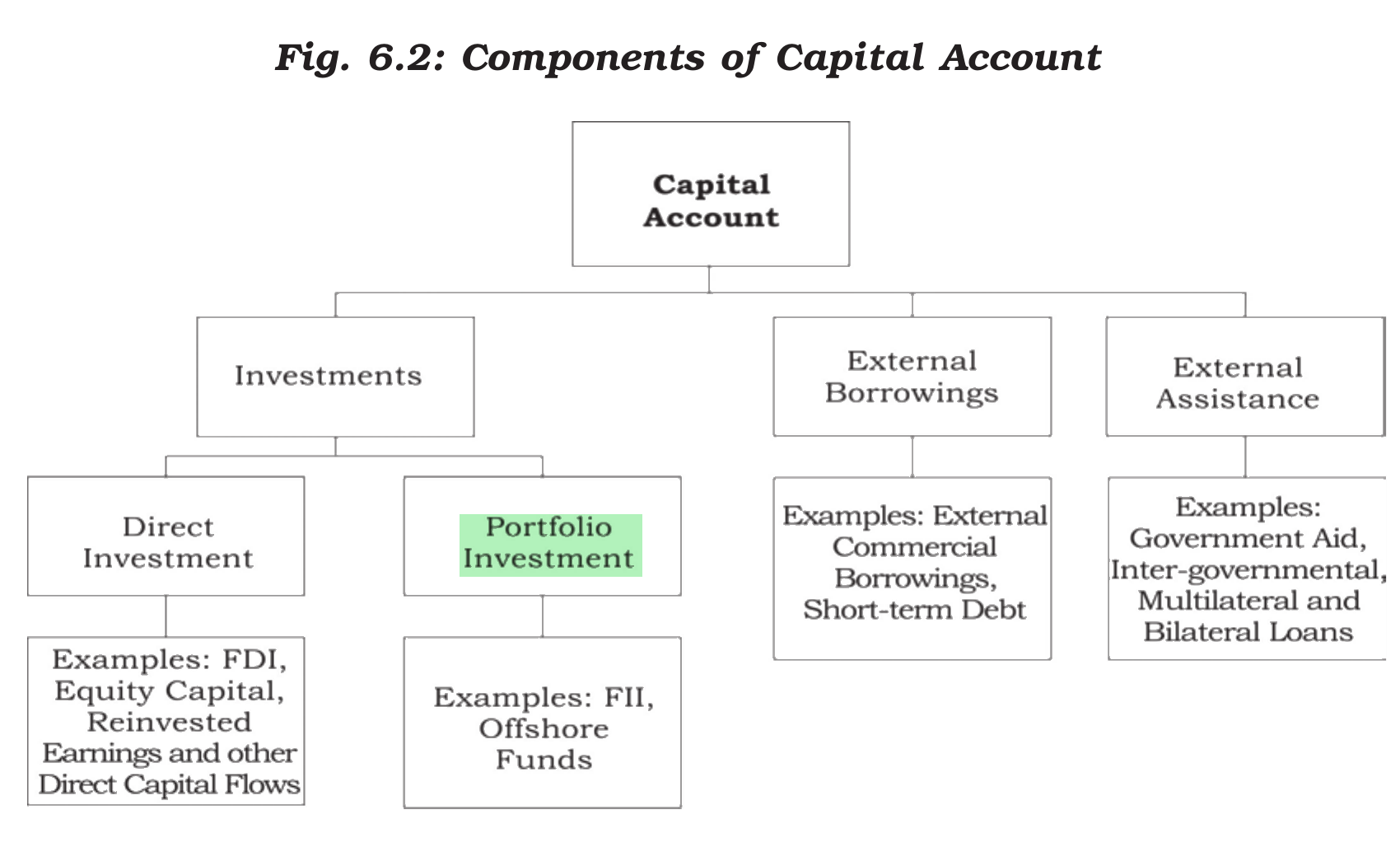
| (D) Capital account | (III) Portfolio investment | The capital account records international transactions of assets, and portfolio investment is one of its items. |
NCERT (2026-27): “Balance on Current Account … Balance of Trade (BOT) is the difference between the value of exports and value of imports of goods of a country in a given period of time. Export of goods is entered as a credit item in BOT, whereas import of goods is entered as a debit item in BOT. It is also known as Trade Balance… 6.1.2 Capital Account … Fig. 6.2 classifies the items which are a part of capital account transactions. These items are Foreign Direct Investments (FDIs), Foreign Institutional Investments (FIIs), external borrowings and assistance… Autonomous and Accommodating Transactions International economic transactions are called autonomous when transactions are made due to some reason other than to bridge the gap in the balance of payments, that is, when they are independent of the state of BoP. One reason could be to earn profit. These items are called ‘above the line’ items in the BoP. The balance of payments is said to be in surplus (deficit) if autonomous receipts are greater (less) than autonomous payments. Accommodating transactions (termed ‘below the line’ items), on the other hand, are determined by the gap in the balance of payments, that is, whether there is a deficit or surplus in the balance of payments. In other words, they are determined by the net consequences of the autonomous transactions…”
|