CUETMOCK
  • Pricing
  • Mentors
Log inStart freeStart free mocks→

First test, then trust

Try a free CUET mock test.

Join 5,00,000+ students who rehearsed exam day on the exact NTA screen before sitting CUET. On the web and on Android.

Start free mocks →Get the Android app
CUETMOCK

India's #1 CUET Mock Test Platform. Original NCERT-based questions on the exact NTA exam screen — trusted by 5,00,000+ students since CUET 2022.

Get it onGoogle PlayScan to download the CUETMOCK app

Mock tests

  • CUET mock test series
  • Browse all papers
  • Commerce mocks
  • Humanities (Arts) mocks
  • Science mocks
  • Languages & GAT mocks
  • Free practice questions
  • Pricing

Resources

  • CUET exam guide
  • CUET syllabus
  • Universities accepting CUET
  • Expert blogs
  • News & notifications
  • Webinars & counselling
  • CUET score calculator
  • How we estimate your rank
  • FAQs

Company

  • About us
  • Our leadership & team
  • Our toppers
  • Mentors
  • For schools
  • Contact us
  • Terms
  • Privacy
  • Refund policy

Talk to us

+91 7696 6630 56info@cuetmock.comWhatsApp us

Our other platforms

  • JEE Mock — For IIT-JEE aspirants
  • NEET Mock — For NEET aspirants

Newsletter

Exam updates, study material and offers — no spam.

© 2026 NYC Ventures Pvt. Ltd.

701-702, Royal Business Park, Zirakpur, Punjab - 140603

  • Terms of use
  • Privacy policy
  • Refund policy
  • Contact us

iCUETMOCK is an independent preparation platform, not affiliated with the National Testing Agency (NTA). Always check exam details on the official NTA website.

  • Home
  • Mock tests
  • CUET guide
  • Pricing
  • Log in
Home/Practice questions/Economics
EconomicsMacro Economics: Determination of Income and Employment

The investment multiplier can be expressed as :

The investment multiplier can be expressed as :

Answer & explanation+

Correct answer: option 2

The correct answer is Option (2) → \( \displaystyle \frac{\Delta Y}{\Delta I} \)

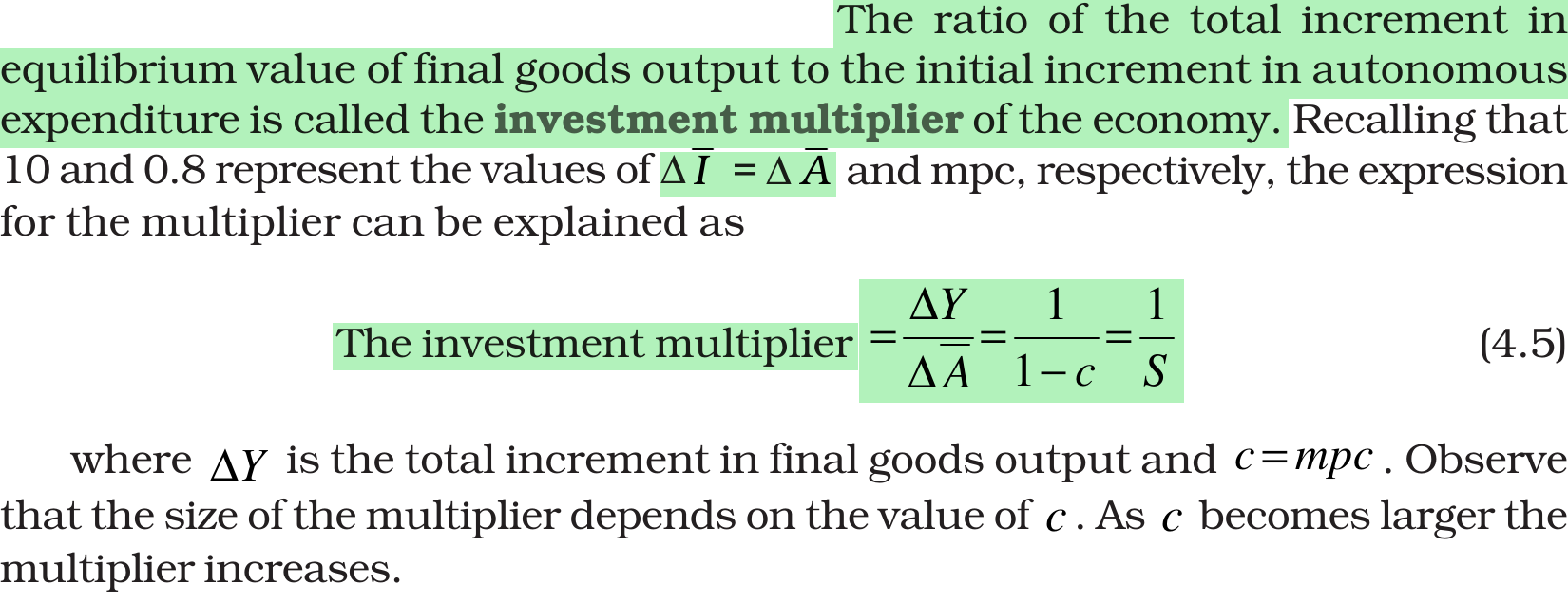
A rise in investment raises income by more than itself, because each round of spending becomes income for someone else. The investment multiplier is the ratio of this total rise in income (ΔY) to the initial rise in investment (ΔI).

It is also equal to 1 / (1 − c), where c is the marginal propensity to consume.

NCERT (2026-27): Introductory Macroeconomics — Chapter 4: Determination of Income and Employment

NCERT extract

Advertisement

Practise more on Macro Economics: Determination of Income and Employment

Chapter-wise mocks on the real NTA exam screen, with solutions and your rank. Your first mocks are free.

Start free mocks →

Advertisement

Next questions

  1. Which of the following statements is correct? A) The National Regulation Fisheries Act of 1897 allows the use of dynamite in the use of ins…Political Science · Contemporary World Politics: Environment and Natural Resources
  2. A and B together can complete a work in 60 minutes, while B and C take 30 minutes and C and A in 40 minutes. Find the time taken by A, B an…General Aptitude Test · Numerical Ability
  3. Net amount payable to Naina is:Accountancy Part A · Dissolution of Partnership Firm
  4. Which of the following is not a merit of external source of recruitment?Business Studies · Staffing
  5. There are two statements marked as Assertion (A) and Reason (R). Mark your answer as per the options given below. Assertion (A): Long-term…Accountancy Part B · Financial Statements of a Company
  6. A founder of modern sociology was also a critic of the economic system built on wage labour. For him, the general acceptance that labour ca…Sociology · Indian Society: Market as a social Institution
  7. Who is known as "Beacon of light of Asia"?General Aptitude Test · General Knowledge
  8. What per cent is 42kg of 336 kg?General Aptitude Test · Numerical Ability
  9. An analysis that enable an assessment of number and types of human resources required to perform various jobs is called as:Business Studies · Staffing
  10. The linear programming problem: Minimise Z=3x+2y Subject to the constraints x+y ≥ 8 3x+5y ≤ 15 x ≥ 0,\ y ≥ 0 hasMaths. Section B1 · Linear Programming