CUETMOCK
  • Pricing
  • Mentors
Log inStart freeStart free mocks→

First test, then trust

Try a free CUET mock test.

Join 5,00,000+ students who rehearsed exam day on the exact NTA screen before sitting CUET. On the web and on Android.

Start free mocks →Get the Android app
CUETMOCK

India's #1 CUET Mock Test Platform. Original NCERT-based questions on the exact NTA exam screen — trusted by 5,00,000+ students since CUET 2022.

Get it onGoogle PlayScan to download the CUETMOCK app

Mock tests

  • CUET mock test series
  • Browse all papers
  • Commerce mocks
  • Humanities (Arts) mocks
  • Science mocks
  • Languages & GAT mocks
  • Free practice questions
  • Pricing

Resources

  • CUET exam guide
  • CUET syllabus
  • Universities accepting CUET
  • Expert blogs
  • News & notifications
  • Webinars & counselling
  • CUET score calculator
  • How we estimate your rank
  • FAQs

Company

  • About us
  • Our leadership & team
  • Our toppers
  • Mentors
  • For schools
  • Contact us
  • Terms
  • Privacy
  • Refund policy

Talk to us

+91 7696 6630 56info@cuetmock.comWhatsApp us

Our other platforms

  • JEE Mock — For IIT-JEE aspirants
  • NEET Mock — For NEET aspirants

Newsletter

Exam updates, study material and offers — no spam.

© 2026 NYC Ventures Pvt. Ltd.

701-702, Royal Business Park, Zirakpur, Punjab - 140603

  • Terms of use
  • Privacy policy
  • Refund policy
  • Contact us

iCUETMOCK is an independent preparation platform, not affiliated with the National Testing Agency (NTA). Always check exam details on the official NTA website.

  • Home
  • Mock tests
  • CUET guide
  • Pricing
  • Log in
Home/Practice questions/Physics
PhysicsRay Optics

When a ray of light passes through a thin walled hollow glass prism o…

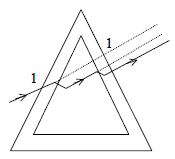
When a ray of light passes through a thin walled hollow glass prism of thickness t and refractive index 1.5.which one is wrong?

Answer & explanation+

Correct answer: option 2

$\text{Thin walled hollow prism} \Rightarrow \text{behaves like parallel glass slab}$

$\text{Angular deviation} = 0 \Rightarrow \text{True}$

$\text{No dispersion (emergent rays parallel)} \Rightarrow \text{True}$

$\text{Lateral shift} = t\left(1 - \frac{1}{\mu}\right) = t\left(1 - \frac{1}{1.5}\right) = \frac{t}{3} \neq \frac{2t}{3}$

$\text{Hence option 4 is incorrect, not option 2}$

The wrong statement is: Lateral shift is equal to $\frac{2t}{3}$.

Advertisement

Practise more on Ray Optics

Chapter-wise mocks on the real NTA exam screen, with solutions and your rank. Your first mocks are free.

Start free mocks →

Advertisement

Next questions

  1. Match the ideas expressed by the phrases in List I with the ideas expressed in List II. LIST I LIST II A. Authors projected I. Unleashed a…English · Comprehension - (Narrative / Factual)
  2. Read the following statements about education and human capital:(A) The labour skill of an educated person is more than that of an uneducat…Economics · Indian Economic Development: Human Capital Formation in India
  3. Identify the agency responsible for Golden Quadrilateral construction and maintenance.Geography · India-People and Economy: Transport and Communcation
  4. Which American President won the Nobel Peace Prize?General Aptitude Test · General Knowledge
  5. Which of the following is the largest reservoir of potable water?General Aptitude Test · General Knowledge
  6. If bananas are bought at the rate of 7 for Rs. 1, how many must be sold for Rs. 1 to gain 40%?General Aptitude Test · Numerical Ability
  7. Which of the following statements is/are NOT correct about commercial livestock ranching?Geography · Fundamentals of Human Geography: Primary Activities
  8. Fill in the blank with the correct noun clause:A tourist at the bus stand asked me ______.English · Grammar: Clauses
  9. K. C. S. Paniker, a pioneer of abstraction in South India, later went on to establish which of the following?Fine Arts · The Modern Indian Art
  10. In this stage, once its function is over, the group may be disbanded. Which stage of group formation is this?Psychology · Social Influence and Group Processes