______ can never be negative while _____ can have value as 1.
Answer & explanation
Correct answer: option 4
The correct answer is Option (4) → MPS, APC
The marginal propensity to save (MPS) cannot be negative, and the average propensity to consume (APC) can equal 1. The three measures behave like this:
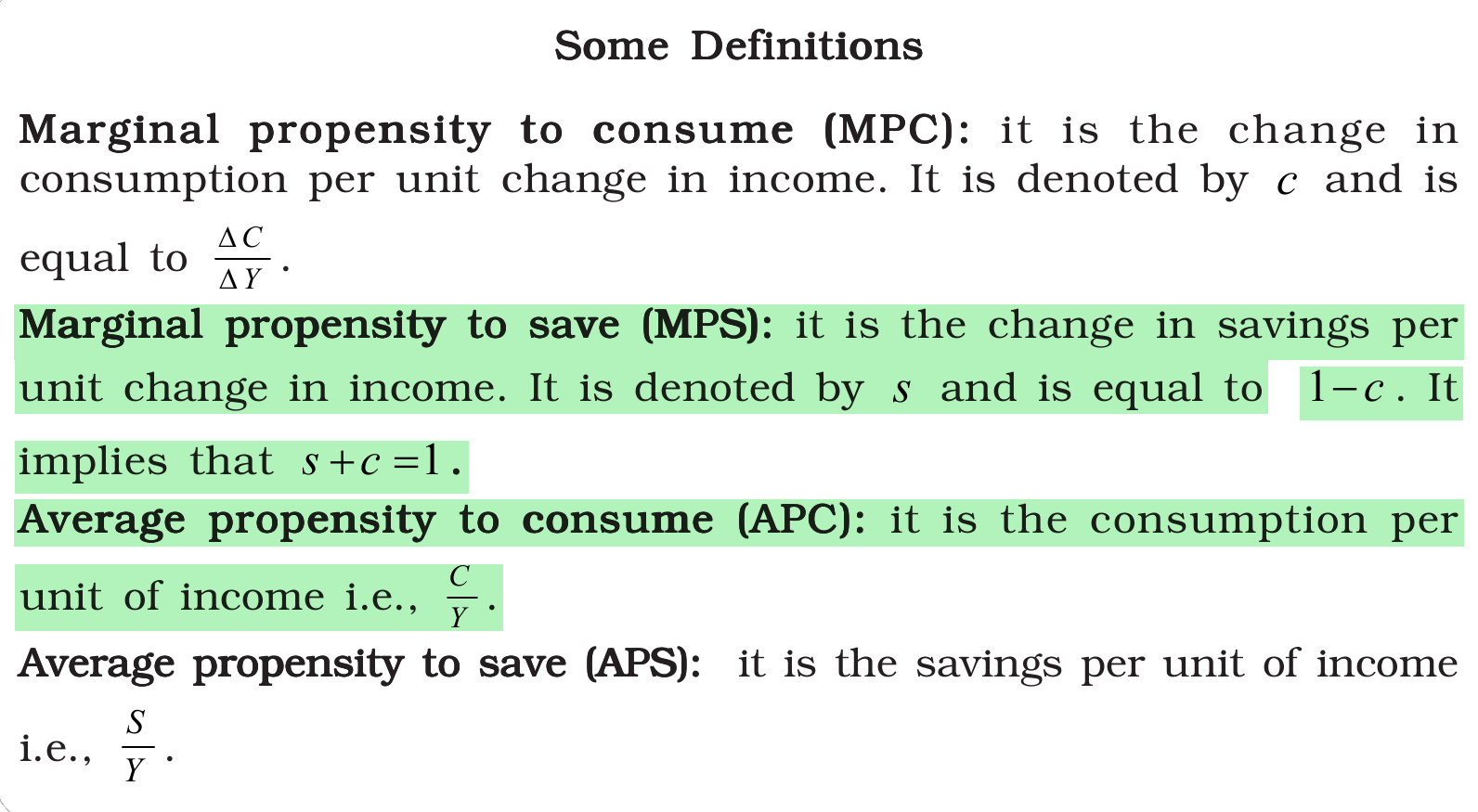
MPS is the change in saving per unit change in income, and equals 1 − MPC. The marginal propensity to consume (MPC) lies between 0 and 1, so MPS also lies between 0 and 1.
APC is consumption per unit of income, C/Y. When consumption equals income, APC = 1.
APS, the average propensity to save, is S/Y. It is negative when consumption is more than income, so it does not fit the first blank. It would equal 1 only if consumption were zero. People consume something even at zero income, so it does not fit the second blank either.
NCERT (2026-27): “4.1.1. Consumption … Now, let us look at the value that MPC can take. When income changes, change in consumption (ΔC) can never exceed the change in income (ΔY). The maximum value which c can take is 1. On the other hand consumer may choose not to change consumption even when income has changed. In this case MPC = 0. Generally, MPC lies between 0 and 1 (inclusive of both values). This means that as income increases either the consumers does not increase consumption at all (MPC = 0) or use entire change in income on consumption (MPC = 1) or use part of the change in income for changing consumption (0< MPC<1).”
|