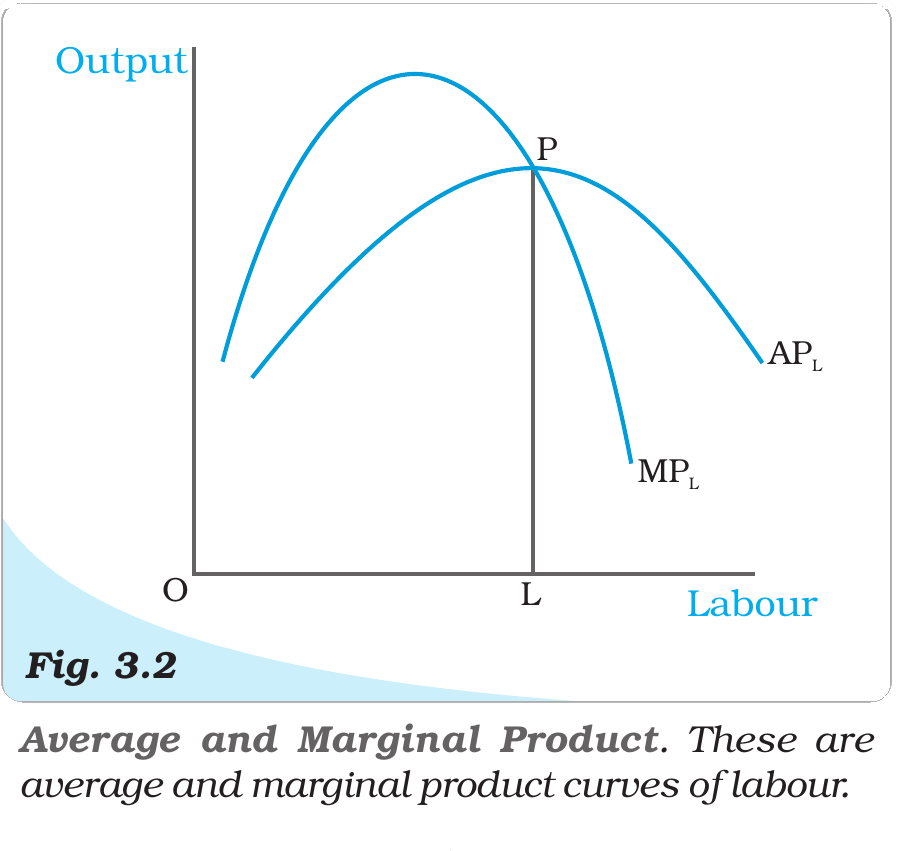
Marginal product (MP) and the average product (AP) curves are inverse 'U'-shaped. Which of the following is correct for AP and MP.
Answer & explanation
Correct answer: option 4
The correct answer is Option (4) → Marginal product curve cuts the average product curve from above at the maximum point of average product curve.
The marginal product (MP) curve cuts the average product (AP) curve from above at the maximum point of AP.
AP is output per unit of the input. MP is the addition to output from one more unit of the input. As long as AP is rising, MP must be greater than AP; otherwise AP cannot rise. When AP falls, MP must be less than AP. So MP comes down from above AP and crosses it at the top of AP.
Option (1) Average product curve cuts the marginal product curve from above at the maximum point of marginal product curve. — Incorrect. MP reaches its highest point earlier, while it is still above AP. The two curves do not meet there.
Option (2) Average product curve cuts the marginal product curve from above at the minimum point of marginal product curve. — Incorrect. The MP curve is inverse ‘U’-shaped. It has a highest point, and the crossing has nothing to do with a lowest point of MP.
Option (3) Marginal product curve cuts the average product curve from above at the minimum point of average product curve. — Incorrect. The AP curve is also inverse ‘U’-shaped. MP crosses it where AP stops rising and starts falling, which is its highest point.
Option (4) Marginal product curve cuts the average product curve from above at the maximum point of average product curve. — Correct. To the left of this point AP is rising and MP is above it. To the right, AP is falling and MP is below it.
NCERT (2026-27): “3.5 Shapes of Total Product, Marginal Product and Average Product Curves … Now as we increase the amount of input, the MP rises. AP being the average of marginal products, also rises, but rises less than MP. Then, after a point, the MP starts falling. However, as long as the value of MP remains higher than the value of the AP, the AP continues to rise. Once MP has fallen sufficiently, its value becomes less than the AP and the AP also starts falling. So AP curve is also inverse ‘U’-shaped. As long as the AP increases, it must be the case that MP is greater than AP. Otherwise, AP cannot rise. Similarly, when AP falls, MP has to be less than AP. It, follows that MP curve cuts AP curve from above at its maximum. Figure 3.2 shows the shapes of AP and MP curves for a typical firm. The AP of factor 1 is maximum at L. To the left of L, AP is rising and MP is greater than AP. To the right of L, AP is falling and MP is less than AP.”
|