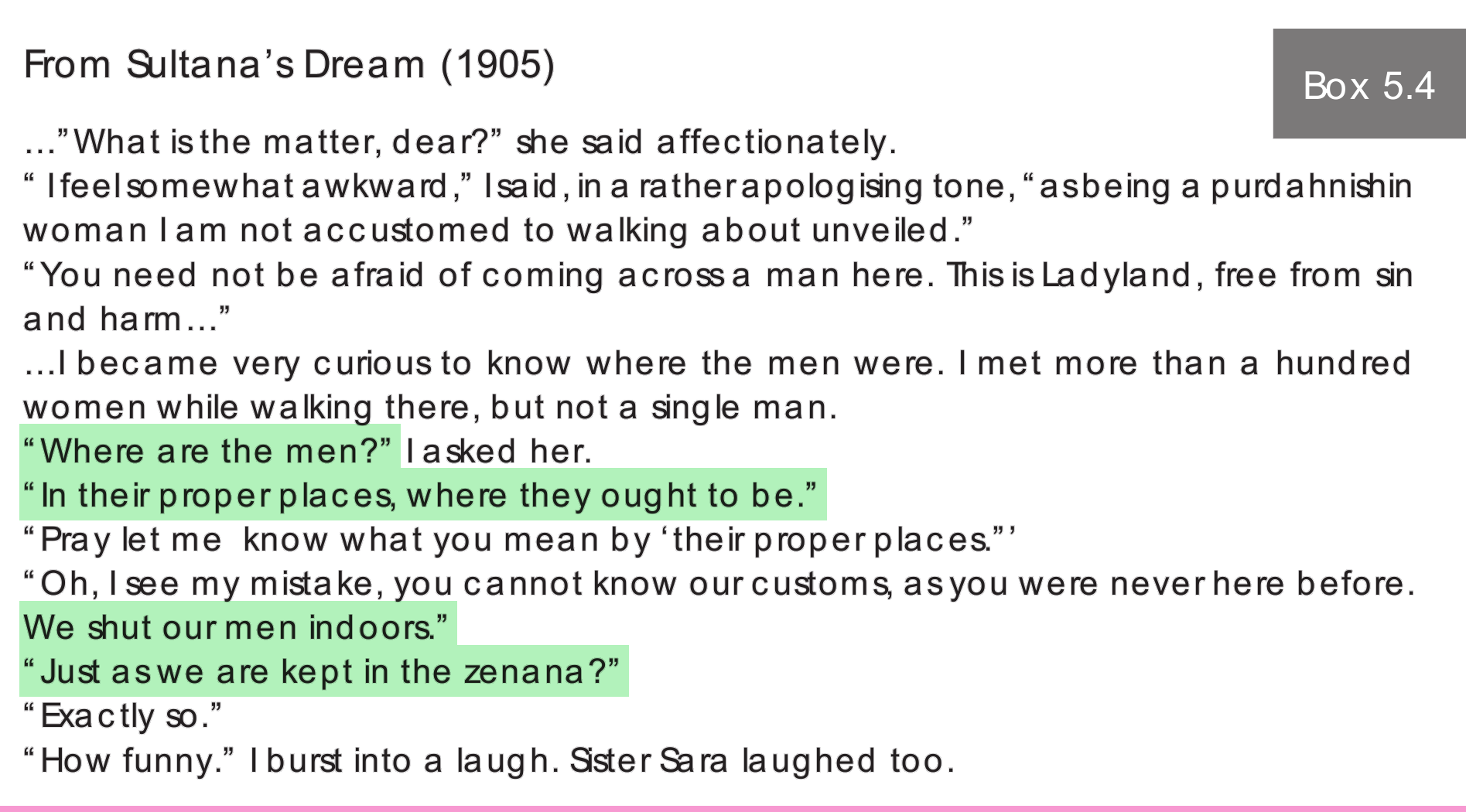
In Begum Rokeya Sakhawat's book "Sultana's Dream" we find the following excerpt, "Where are the men ?..., where they ought to be... we shut our men indoors... just as we are kept in the zenana ?", What do these lines describe?
Answer & explanation
Correct answer: option 3
The correct answer is Option (3) → Reversal of roles of Gender
Note: The given answer is as per the official NTA Answer Key. However, Option (4) can also be considered correct, as explained below.
Option (1) Double standard imposed by male dominated society — Incorrect. A double standard is one rule for men and another for women. That was the theme of a different book, Tarabai Shinde’s Stree Purush Tulana (1882), written as a protest against the double standards of a male dominated society after a young widow was sentenced to death while the man involved was never punished. The lines from Sultana’s Dream do not compare two rules.
Option (2) Comparison of work done by men and women in a male dominated society — Incorrect. Stree Purush Tulana means ‘Comparison of Men and Women’, which is where this option’s idea comes from. The lines here compare no work; they describe men being shut indoors.
Option (3) Reversal of roles of Gender — Correct as per NTA. In Sultana’s Dream (1905), Begum Rokeya Sakhawat Hossain’s Sultana visits a magical country where the gender roles are reversed. Men are confined to the home and observe ‘purdah’, while women are busy scientists. When Sultana asks where the men are, she is told ‘We shut our men indoors’, ‘just as we are kept in the zenana’: the place society gave to women is now given to men.
Option (4) Challenging patriarchy — Can also be considered correct. Patriarchy is a social system in which men hold power over women. By shutting men indoors ‘just as we are kept in the zenana’, the lines turn upside down the place a male dominated society gives to women, and so they can also be read as challenging patriarchy. But the question asks what these lines describe, and what they describe directly is men and women changing places, that is, a reversal of gender roles, Option (3).
NCERT (2025-26): “5.3 Struggle for women’s equality and rights … Stree Purush Tulana (or Comparison of Men and Women) was written by a Maharashtrian housewife, Tarabai Shinde, as a protest against the double standards of a male dominated society. A young Brahmin widow had been sentenced to death by the courts for killing her newborn baby because it was illegitimate, but no effort had been made to identify or punish the man who had fathered the baby. Stree Purush Tulana created quite a stir when it was published.…” “…In her dream, Sultana visits a magical country where the gender roles are reversed. Men are confined to the home and observe ‘purdah’ while women are busy scientists vying with each other at inventing devices that will control the clouds and regulate rain, and machines that fly or ‘air-cars’.…”
|