Zone refining is mainly used for:
Answer & explanation
Correct answer: option 2
The correct answer is Option (2) → Ga
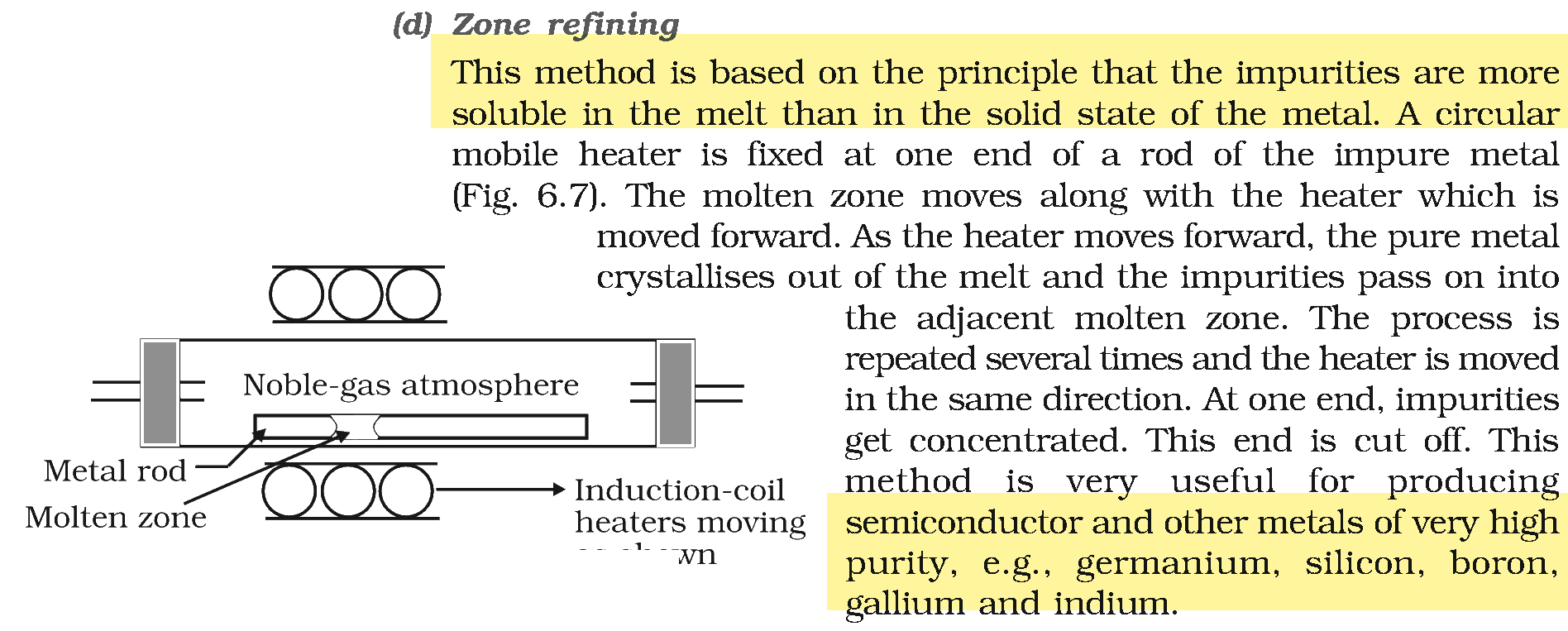
Zone refining is based on the principle that impurities are more soluble in the melt than in the solid metal. A circular heater moves slowly along a rod of the impure metal; the molten zone carries the impurities with it to one end, and pure metal crystallises behind it. Repeating the process gives metals of very high purity, which is why it is used for semiconductors and similar elements: germanium, silicon, boron, gallium and indium.
Why the other options are incorrect
Option (1) Ni — Incorrect. Nickel is refined by the Mond process: \( \ce{Ni + 4CO} \xrightarrow{\text{330-350 K}} \ce{Ni(CO)4} \), and the volatile carbonyl decomposes at 450–470 K to pure Ni.
Option (3) Zr — Incorrect. Zirconium is refined by the van Arkel method: \( \ce{Zr + 2I2 -> ZrI4} \), and \( \ce{ZrI4} \) decomposes on a hot tungsten filament (about 1800 K) to pure Zr.
Option (4) Ta — Incorrect. Tantalum is not refined this way; zone refining is used for the ultra-pure semiconductor elements (Ge, Si, B, Ga, In).
Note: This question is from the pre-rationalised NCERT book (2022-23). The topic is not there in the latest NCERT book (2026-27), and it is also out of the CUET 2026 syllabus.
NCERT (Pre-rationalised edition, 2022-23):
Zone Refining