Choose the alcohol which on oxidation with chromic anhydride will give a ketone.
Answer & explanation
Correct answer: option 3
The correct answer is Option (3) → cyclohexanol
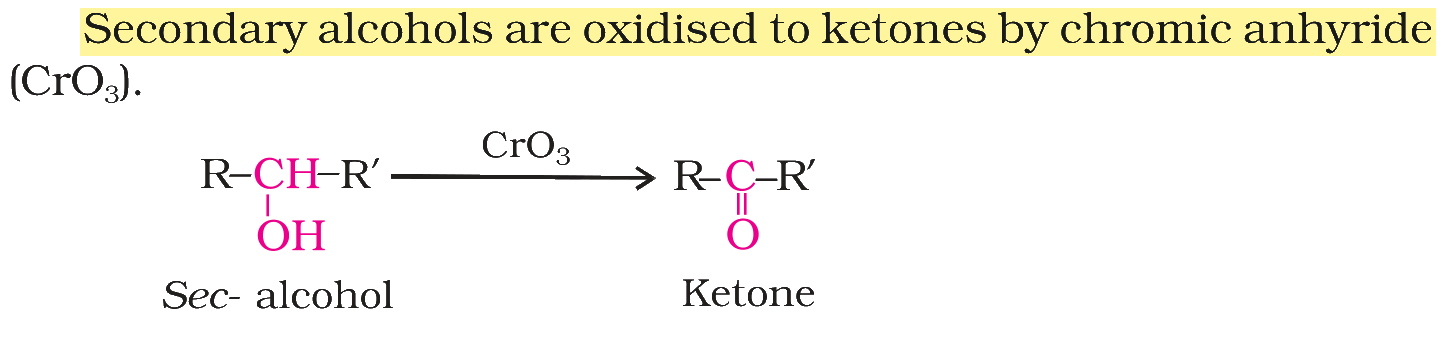
The product of oxidising an alcohol depends on its class, that is, on the number of hydrogens on the carbon carrying the –OH group. Primary alcohols (–\( \ce{CH2OH} \)) give aldehydes and then carboxylic acids. Secondary alcohols (>CH–OH) are oxidised to ketones by chromic anhydride, \( \ce{CrO3} \). Tertiary alcohols have no H on that carbon and are not oxidised under these conditions.
Cyclohexanol is a secondary alcohol: its –OH carbon is joined to two ring carbons and one H. Oxidation removes that H and the H of –OH and gives cyclohexanone:
\( \displaystyle \ce{C6H11OH} \xrightarrow{\ce{CrO3}} \ce{C6H10O}\ \text{(cyclohexanone)} \)
So the alcohol that gives a ketone is cyclohexanol.
Why the other options are incorrect
Option (1) phenol — Incorrect. The –OH is on an sp2 ring carbon that has no H to lose, so phenol does not undergo this oxidation; with chromic acid the ring itself is oxidised to benzoquinone.
Option (2) benzyl alcohol — Incorrect. \( \ce{C6H5CH2OH} \) is a primary alcohol; it gives benzaldehyde and then benzoic acid.
Option (4) cyclohexylmethanol — Incorrect. \( \ce{C6H11CH2OH} \) is also primary; it gives cyclohexanecarbaldehyde and then cyclohexanecarboxylic acid.
Note: The NCERT book (2026-27) prints “chromic anhyride”; it should read “chromic anhydride”.
NCERT (2026-27 edition):
Oxidation – …