CUETMOCK
  • Pricing
  • Mentors
Log inStart freeStart free mocks→

First test, then trust

Try a free CUET mock test.

Join 5,00,000+ students who rehearsed exam day on the exact NTA screen before sitting CUET. On the web and on Android.

Start free mocks →Get the Android app
CUETMOCK

India's #1 CUET Mock Test Platform. Original NCERT-based questions on the exact NTA exam screen — trusted by 5,00,000+ students since CUET 2022.

Get it onGoogle PlayScan to download the CUETMOCK app

Mock tests

  • CUET mock test series
  • Browse all papers
  • Commerce mocks
  • Humanities (Arts) mocks
  • Science mocks
  • Languages & GAT mocks
  • Free practice questions
  • Pricing

Resources

  • CUET exam guide
  • CUET syllabus
  • Universities accepting CUET
  • Expert blogs
  • News & notifications
  • Webinars & counselling
  • CUET score calculator
  • How we estimate your rank
  • FAQs

Company

  • About us
  • Our leadership & team
  • Our toppers
  • Mentors
  • For schools
  • Contact us
  • Terms
  • Privacy
  • Refund policy

Talk to us

+91 7696 6630 56info@cuetmock.comWhatsApp us

Our other platforms

  • JEE Mock — For IIT-JEE aspirants
  • NEET Mock — For NEET aspirants

Newsletter

Exam updates, study material and offers — no spam.

© 2026 NYC Ventures Pvt. Ltd.

701-702, Royal Business Park, Zirakpur, Punjab - 140603

  • Terms of use
  • Privacy policy
  • Refund policy
  • Contact us

iCUETMOCK is an independent preparation platform, not affiliated with the National Testing Agency (NTA). Always check exam details on the official NTA website.

  • Home
  • Mock tests
  • CUET guide
  • Pricing
  • Log in
Home/Practice questions/Sociology
SociologySocial Change and Development in India: Change and Development in Rural Society

Arrange the following in the sequence as they happened in Indian Econ…

Arrange the following in the sequence as they happened in Indian Economy:

(A) Green Revolution
(B) Liberalisation
(C) Land Reform Policies
(D) Raiyatwari System
(E) Agrarian Distress

Choose the correct answer from the options given below:

Answer & explanation+

Correct answer: option 1

The correct answer is Option (1) → (D), (C), (A), (B), (E)

(D) Raiyatwari System — a colonial system of land settlement in areas under direct British rule, in which the ‘actual cultivators’ rather than the zamindars paid the land tax.

(C) Land Reform Policies — after independence, from the 1950s to the 1970s, a series of land reform laws was passed: the abolition of zamindari, tenancy laws and land ceiling acts.

(A) Green Revolution — the government programme of agricultural modernisation of the 1960s and 1970s, based on high-yielding seeds, fertilisers and pesticides.

(B) Liberalisation — the policy the Indian state took up since 1991 to open the economy to the world market, which exposed Indian agriculture to the forces of globalisation.

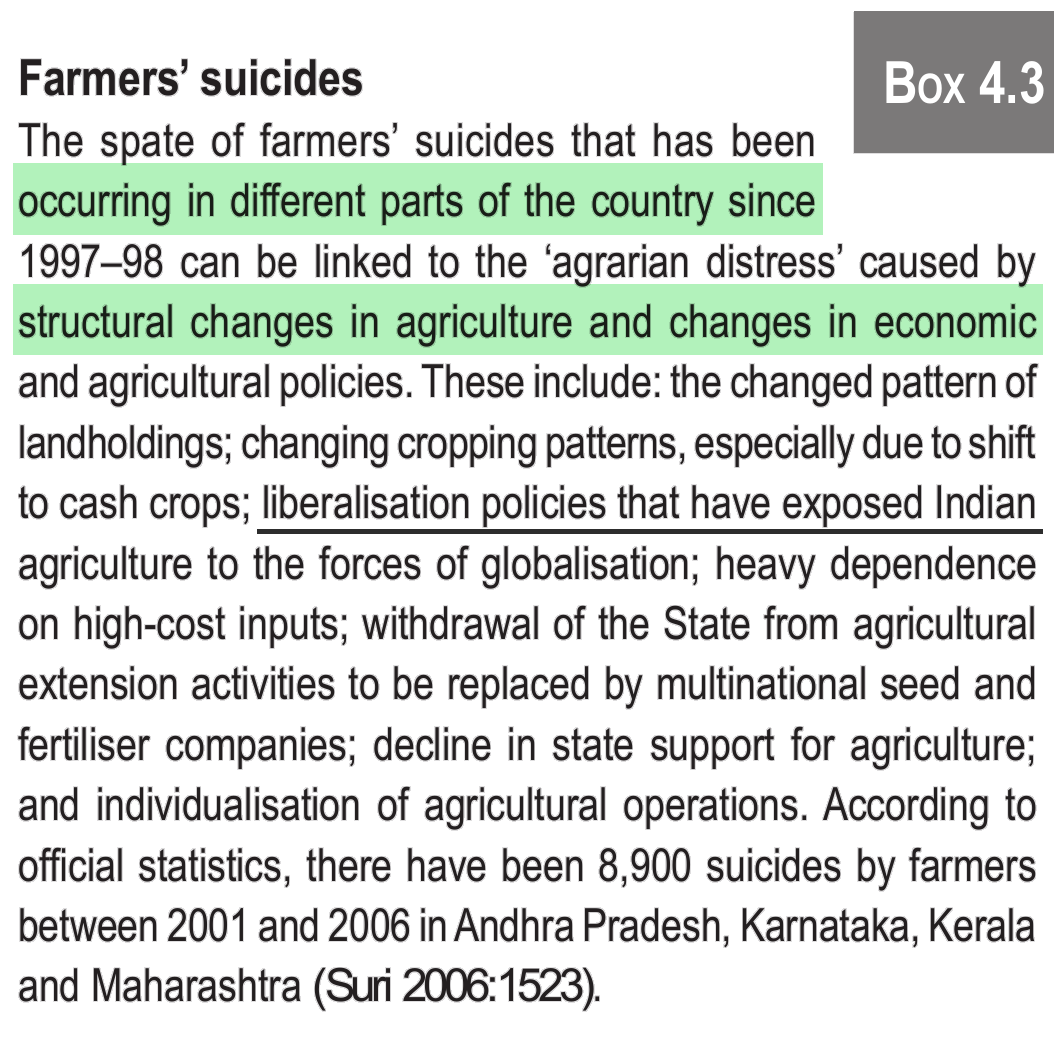
(E) Agrarian Distress — the spate of farmers’ suicides since 1997–98 has been linked to agrarian distress caused by structural changes in agriculture, liberalisation policies among them.


NCERT (2025-26): “The Colonial Period … Many districts of colonial India were administered through the zamindari system. In other areas that were under direct British rule had what was called the raiyatwari system of land settlement (raiyat means cultivator in Telugu). In this system, the ‘actual cultivators’ (who were themselves often landlords and not cultivators) rather than the zamindars were responsible for paying the tax.…”

“Independent India … After India became independent, Nehru and his policy advisors embarked on a programme of planned development that focused on agrarian reform as well as industrialisation. The policymakers were responding to the dismal agricultural situation in India at that time. This was marked by low productivity, dependence on imported food grains, and the intense poverty of a large section of the rural population. They felt that a major reform in the agrarian structure, and especially in the landholding system and the distribution of land, was necessary if agriculture were to progress. From the 1950s to the 1970s, a series of land reform laws were passed – at the national level as well as in the states – that were intended to bring about these changes.…”

“4.3 The Green Revolution and its Social Consequences … We saw that land reforms have had only a limited impact on rural society and the agrarian structure in most regions. In contrast the Green Revolution of the 1960s and 1970s brought about significant changes in the areas where it took place.…”

NCERT extract

Box 4.3, Farmers’ suicides

Advertisement

Practise more on Social Change and Development in India: Change and Development in Rural Society

Chapter-wise mocks on the real NTA exam screen, with solutions and your rank. Your first mocks are free.

Start free mocks →

Advertisement

Next questions

  1. Select the most appropriate option to fill in the blank. He is both diligent ______ efficient.English · Fill Blanks
  2. Select the correct option that indicates the arrangement of the given words in the order in which they appear in an English dictionary. 1.…General Aptitude Test · Verbal Reasoning
  3. If r, a, b, c are non null vectors such that vec r.vec a=vec r.vec b=vec r.vec c=0, then [vec a vec b vec c]Maths. Section B1 · Vectors
  4. Fill in the blank with an appropriate option. Wash, rinse and drain water from quinoa and ________.English · Fill Blanks
  5. Choose correct sequence of first five steps of screen based trading for buying and selling of securities. A. Approach a registered broker B…Business Studies · Financial Markets
  6. Choose the correct option to fill in the blank:At the age of seven, Kavya ______ play the harmonium so well that the village temple invited…English · Grammar: Modal
  7. Arrange the following in a chronological order. A. Non-Cooperation MovementB. Jallianwala Bagh MassacreC. Champaran MovementD. Gandhi-Irwin…History · Modern India: Mahatma Gandhi and the Nationalist movement
  8. Match List-I with List-IIList-I (Pigments)List-II (Source)(A) Vermilion(I) Charcoal(B) Ultramarine(II) Orpiment(C) Yellow(III) Cinnabar(D)…Fine Arts · The Mughal School of Miniature Painting
  9. What is the radius of the circular orbit of a satellite moving with an angular speed equal to the angular speed of earth's rotation.Physics · Gravitation
  10. Select the wrongly spelt word.English · Spelling Check