
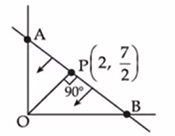
In the adjoining figure, the inequality representing AB is:
Answer & explanation
Correct answer: option 3
The correct answer is Option (3) → \(8x+14y \le 65\)
The figure shows that P lies on AB and that OP is perpendicular to AB.
Slope of OP, from O(0, 0) to \(P\left(2, \frac{7}{2}\right)\):
\( \displaystyle m_{OP} = \frac{7/2}{2} = \frac{7}{4} \)
Perpendicular lines have slopes with product −1, so
\( \displaystyle m_{AB} = -\frac{4}{7} \)
Line AB through \(P\left(2, \frac{7}{2}\right)\):
\( \displaystyle y - \frac{7}{2} = -\frac{4}{7}(x - 2) \)
Multiplying by 14:
\(14y - 49 = -8x + 16\)
\(8x + 14y = 65\)
The arrows on AB point towards the origin, so the region is the side of AB that contains O. At O, \(8(0) + 14(0) = 0 \le 65\), so the inequality is
\(8x + 14y \le 65\)
Why the other options are incorrect
Option (1) \(14x+8y \le 65\) — Incorrect. The coefficients are swapped: at P, \(14(2) + 8\left(\frac{7}{2}\right) = 56 \ne 65\), so this line does not pass through P.
Option (2) \(x+2y \le 9\) — Incorrect. This line passes through P (2 + 7 = 9), but its slope is \(-\frac{1}{2}\), and \(-\frac{1}{2} \times \frac{7}{4} \ne -1\), so it is not perpendicular to OP.
Option (4) \(4x+6y \le 29\) — Incorrect. This line also passes through P (8 + 21 = 29), but its slope is \(-\frac{2}{3}\), and \(-\frac{2}{3} \times \frac{7}{4} \ne -1\), so it is not perpendicular to OP.