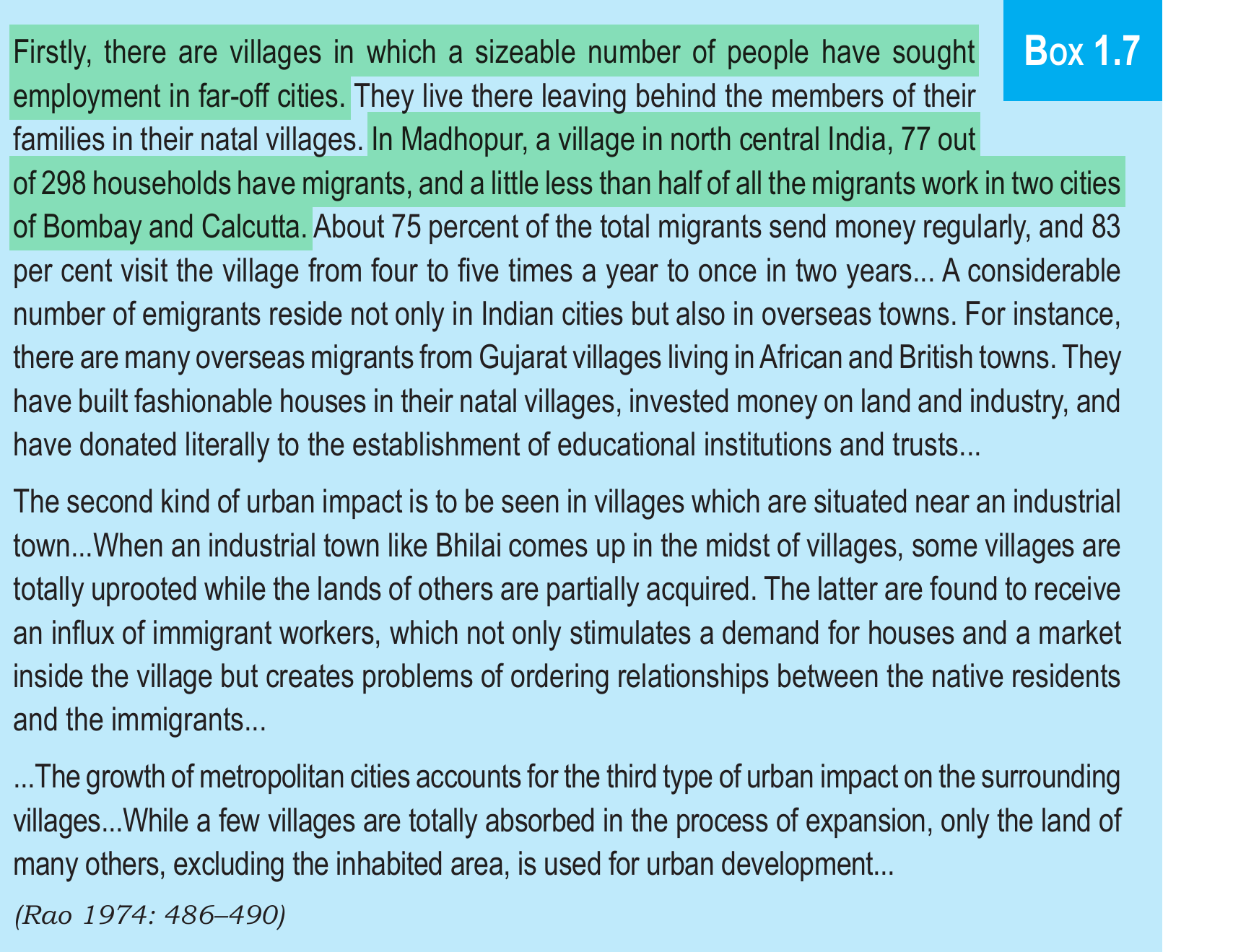
In Madhopur, a village in north central India, 77 out of 298 households have migrants and little less than half of all the migrant work in cities like Bombay and Calcutta. What does the example reflect?
Answer & explanation
Correct answer: option 3
The correct answer is Option (3) → Urbanisation
Note 1: The given answer is as per the official NTA Answer Key. However, the question can have more than one correct answer, i.e. both Option (2) and Option (3), as explained below.
Option (1) Industrialisation — Incorrect. Industrialisation is the growth of machine production in factories. The example counts the households of a village who have members working in far-off cities; it says nothing about factories coming up.
Option (2) Migration — Can also be considered correct. Migration is the movement of people from one place to another to live or work. Of the 298 households of Madhopur, 77 have migrants, and a little less than half of the migrants work in Bombay and Calcutta, so the example is a direct case of migration from village to city.
Option (3) Urbanisation — Correct as per NTA. Sociologist M.S.A. Rao argued that many villages all over India are coming under the impact of urban influences, and he described three kinds of urban impact. Madhopur is his example of the first kind: villages in which a sizeable number of people have sought employment in far-off cities, leaving their families in the village, sending money home and visiting regularly. Read this way, the example shows urbanisation reaching into the village.
Option (4) Ghettoisation — Incorrect. Ghettoisation is the process by which the people of one community come to live crowded together in a separate area of a city, cut off from others, as when a minority settles in one locality for safety. The example is about villagers working in distant cities, not about a closed community area.
Tip for students: When an example fits two answers, recall the topic under which it is studied. Madhopur is the example in M.S.A. Rao’s account of the urban impact on villages, which is why urbanisation is the answer given by NTA here.
Note 2: The concept in Option (4), ‘ghettoisation’, is not in NCERT (2025-26); explained here for the benefit of the students.
NCERT (2025-26): “Urbanisation in Independent India … Writing on the different kinds of urbanisation witnesses in the first two decades after independence sociologist M.S.A. Rao argued that in India many villages all over India are becoming increasingly subject to the impact of urban influences. But the nature of urban impact varies according to the kind of relations a village has with a city or town. He describes three different situations of urban impact as mentioned in the box.”
Box 1.7 |