
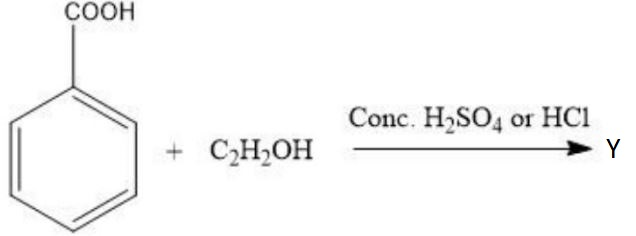
Major product Y in the following reaction is
Answer & explanation
Correct answer: option 4
The correct answer is Option (4) → ethyl benzoate
A carboxylic acid heated with an alcohol in the presence of a mineral acid catalyst (concentrated \( \ce{H2SO4} \) or HCl gas) gives an ester and water. This is esterification, a nucleophilic acyl substitution. The acid protonates the carbonyl oxygen, which makes the carbonyl carbon more open to attack; the alcohol adds to it, and after proton transfer a molecule of water is lost. The reaction is reversible, so the water formed is removed to push it forward.
Benzoic acid and ethanol give ethyl benzoate:
\( \displaystyle \ce{C6H5COOH + C2H5OH} \xrightarrow{\text{conc. }\ce{H2SO4}} \ce{C6H5COOC2H5 + H2O} \)
The –OH of the acid is replaced by the –\( \ce{OC2H5} \) group of the alcohol, so Y is ethyl benzoate, the structure in Option (4).
Why the other options are incorrect
Option (1) propiophenone, \( \ce{C6H5COC2H5} \) — Incorrect. This ketone has the ethyl group joined to carbon, not through oxygen; it is made by Friedel-Crafts acylation of benzene with propanoyl chloride and anhydrous \( \ce{AlCl3} \).
Option (2) benzyl alcohol, \( \ce{C6H5CH2OH} \) — Incorrect. This is the product of reducing benzoic acid with lithium aluminium hydride; ethanol and acid do not reduce the –COOH group.
Option (3) acetophenone, \( \ce{C6H5COCH3} \) — Incorrect. This ketone comes from Friedel-Crafts acylation of benzene with acetyl chloride; it has no ethyl group at all.
NCERT (2026-27 edition):
Reactions Involving Cleavage of C–OH Bond – “… Carboxylic acids are esterified with alcohols or phenols in the presence of a mineral acid such as concentrated H2SO4 or HCl gas as a catalyst.”