
A spherical air lens of radii \( R_1 = R_2 = 10\,\mathrm{cm} \) is cut from a glass \( (\mu = 1.5) \) cylinder as shown in figure. Its focal length is \( f_1 \). If a liquid of refractive index 2 is filled in the space then the focal length of liquid lens becomes \( f_2 \). Calculate \( f_1 \) and \( f_2 \). Choose the correct options from the following.
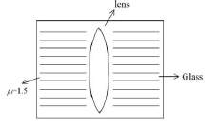
Answer & explanation
Correct answer: option 3
The correct answer is Option (3) → \( f_1 = -15\,\mathrm{cm},\ f_2 = +15\,\mathrm{cm} \)
The lens maker's formula uses the refractive index of the lens material relative to the surrounding medium, \( \mu_{\mathrm{rel}} = \mu_{\mathrm{lens}}/\mu_{\mathrm{medium}} \):
\( \displaystyle \frac{1}{f} = (\mu_{\mathrm{rel}} - 1)\left(\frac{1}{R_1} - \frac{1}{R_2}\right) \)
The air lens has a double-convex shape, so \( R_1 = +10\,\mathrm{cm} \) and \( R_2 = -10\,\mathrm{cm} \), giving \( \frac{1}{R_1} - \frac{1}{R_2} = \frac{1}{5}\,\mathrm{cm^{-1}} \).
Air lens in glass
\( \displaystyle \mu_{\mathrm{rel}} = \frac{1}{1.5} = \frac{2}{3} \)
\( \displaystyle \frac{1}{f_1} = \left(\frac{2}{3} - 1\right)\times\frac{1}{5} = -\frac{1}{15} \Rightarrow f_1 = -15\,\mathrm{cm} \)
Liquid (\( \mu = 2 \)) in the same space
\( \displaystyle \mu_{\mathrm{rel}} = \frac{2}{1.5} = \frac{4}{3} \)
\( \displaystyle \frac{1}{f_2} = \left(\frac{4}{3} - 1\right)\times\frac{1}{5} = \frac{1}{15} \Rightarrow f_2 = +15\,\mathrm{cm} \)