
What is the first step in acid catalyzed dehydration of alcohol?
Answer & explanation
Correct answer: option 4
The correct answer is Option (4) → Protonation of alcohol
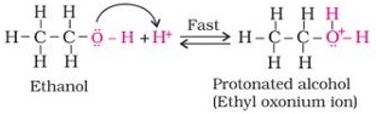
In acid-catalyzed dehydration, the -OH group of alcohol is a poor leaving group. Acid first protonates the alcohol, converting $-OH$ into ${-OH_2}^+$ (water), which is a much better leaving group.
Step 1: Formation of protonated alcohol.
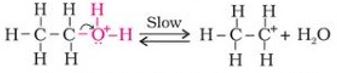
Step 2: Formation of carbocation: It is the slowest step and hence, the rate determining step of the reaction.
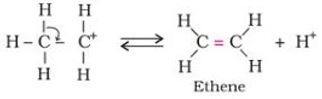
Step 3: Formation of ethene by elimination of a proton.
Option-wise Explanation
1. Removal of OH
-OH cannot leave directly because it is a strong base and poor leaving group. Without protonation, this step is energetically unfavorable and does not occur first.
2. Removal of water
Water leaves only after protonation of the alcohol forms an oxonium ion (${ROH_2}^+$). So this is a later step, not the first one.
3. Elimination of proton
Loss of a proton (deprotonation) happens in the final step to form the alkene. This step restores neutrality after carbocation formation.
4. Protonation of alcohol
The acid donates H* to the oxygen of alcohol, forming ${ROH_2}^+$. This activates the molecule and allows water to leave, initiating dehydration.