Read the passage and answer the following question:
The Meghalaya Succession Act (passed by an all-male Meghalaya legislative assembly) received the President's assent in 1986. The Succession Act applies specifically to the Khasi and Jaintia tribes of Meghalaya and confers on 'any Khasi and Jaintia of sound mind not being a minor, the right to dispose of his self-acquired property by will'. The practice of making out a will does not exist in Khasi custom. Khasi custom prescribes the devolution of ancestral property in the female line.
There is a feeling, specially among the educated Khasi, that their rules of kinship and inheritance are biased in favour of women and are too restrictive. The Succession Act is therefore seen as an attempt of removing such restrictions and at correcting the perceived female bias in the Khasi tradition. To assess whether the popular perception of female bias in the Khasi tradition is indeed valid, it is necessary to view the Khasi matrilineal system in the context of the prevalent gender relations and definitions of gender roles.
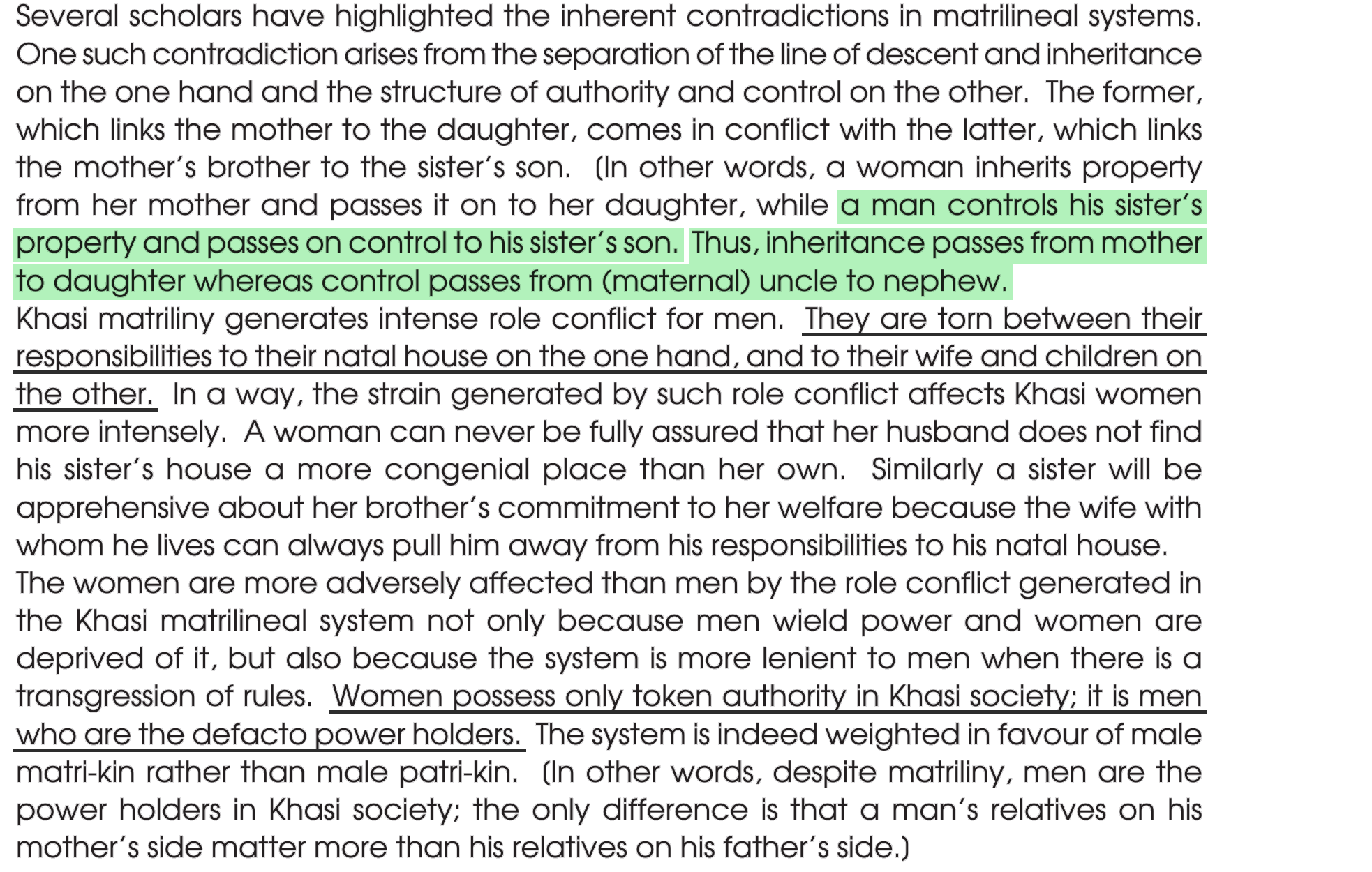
Several scholars have highlighted the inherent contradictions in matrilineal systems. One such contradiction arises from the separation of the line of descent and inheritance on the one hand and the structure of authority and control on the other. The former, which links the mother to the daughter, comes in conflict with the latter, which links the mother's brother to the sister's son. (In other words, a woman inherits property from her mother and passes it on to her daughter, while a man controls his sister's property and passes on control to his sister's son. Thus, inheritance passes from mother to daughter whereas control passes from (maternal) uncle to nephew.)
Khasi matriliny generates intense role conflict for men. They are torn between their responsibilities to their natal house on the one hand, and to their wife and children on the other. In a way, the strain generated by such role conflict affects Khasi women more intensely. A woman can never be fully assured that her husband does not find his sister's house a more congenial place than her own. Similarly a sister will be apprehensive about her brother's commitment to her welfare because the wife with whom he lives can always pull him away from his responsibilities to his natal house.
The women are more adversely affected than men by the role conflict generated in the Khasi matrilineal system not only because men wield power and women are deprived of it, but also because the system is more lenient to men when there is a transgression of rules. Women possess only token authority in Khasi society; it is men who are the defacto power holders. The system is indeed weighted in favour of male matri-kin rather than male patri-kin. (In other words, despite matriliny, men are the power holders in Khasi society; the only difference is that a man's relatives on his mother's side matter more than his relatives on his father's side.)
In the Khasi system of inheritance, identify the source reason of the conflict:
Answer & explanation
Correct answer: option 3
The correct answer is Option (3) → Inheritance passes from mother to daughter whereas control passes from uncle to nephew.
Option (1) Women are the power holders, while men control the property. — Incorrect. This turns the facts upside down. In Khasi society women possess only token authority and men are the de facto power holders, while the property itself is inherited by women.
Option (2) Women have all the power and the non-tribal wider society is patriarchal, so Khasi men feel inadequate. — Incorrect. Khasi women do not have all the power; they hold only token authority. The strain on men that the passage describes is a role conflict: they are torn between their natal house and their wife and children, not made to feel inadequate by powerful women.
Option (3) Inheritance passes from mother to daughter whereas control passes from uncle to nephew. — Correct. The conflict comes from the separation of the line of descent and inheritance from the structure of authority and control. A woman inherits property from her mother and passes it on to her daughter, but a man controls his sister’s property and passes that control on to his sister’s son. So inheritance passes from mother to daughter, while control passes from the maternal uncle to the nephew, and the two lines pull against each other.
Option (4) Women and men share property jointly from both mother and father. — Incorrect. Khasi custom passes ancestral property only in the female line; there is no joint sharing of property from both parents.
Note: Box 3.3 on the Khasi matrilineal family, from which this passage is taken, was there in the pre-rationalised NCERT, which NTA followed in 2023, and has been deleted from the NCERT book (2025-26).
NCERT: Indian Society — Chapter 3: Social Institutions: Continuity and Change, Box 3.3 (Pre-rationalised)
|