Once the datesheet was announced, the students started paying attention and preparing for the examination. They made notes, took tests and attended coaching class neglecting their diet and sleep. As the examination approached students felt draining of bodily resources and falling sick indicates _________ stage of General Adaptation Syndrome.
Answer & explanation
Correct answer: option 1
The correct answer is Option (1) → Exhaustion stage
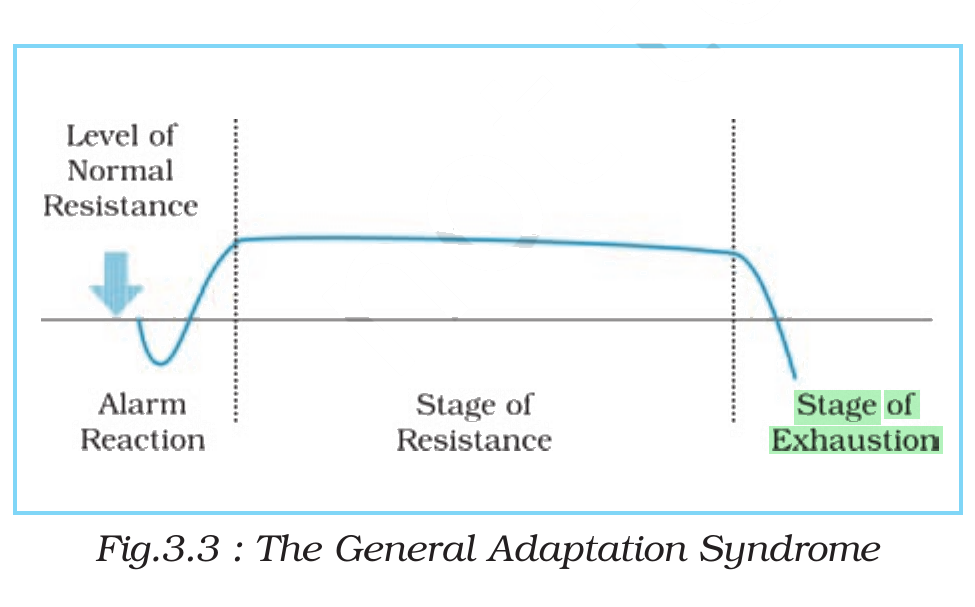
Hans Selye’s General Adaptation Syndrome (GAS) has three stages: alarm reaction, resistance, and exhaustion. The students first faced the stressor, kept on working under it and neglected diet and sleep, and in the end their bodily resources were drained and they fell sick.
Option (1) Exhaustion stage — Correct. Continued exposure to the same stressor drains the body of its resources; the systems of alarm and resistance become ineffective and stress-related diseases become more likely. Falling sick as the examination approaches is this stage.
Option (2) Alarm reaction stage — Incorrect. This is the first response to a stressor: the adrenal-pituitary-cortex system is activated, hormones are released, and the person is ready for fight or flight. It matches the moment the datesheet was announced, not the end.
Option (3) Resistance stage — Incorrect. If stress is prolonged, the body makes efforts to cope with the threat and uses its resources more cautiously. The weeks of preparation are this stage; the draining of resources comes after it.
Option (4) Adjourning stage — Incorrect. Adjourning is the last stage of group formation in Tuckman’s model, when the group is disbanded after its purpose is achieved. It does not belong to the GAS.
NCERT (2025-26): “General Adaptation Syndrome … Selye noticed a similar pattern of bodily response in all of them. He called this pattern the General Adaptation Syndrome (GAS). According to him, GAS involves three stages: alarm reaction, resistance, and exhaustion (see Fig.3.3).
|