
Read the passage carefully and answer.
The molar conductivity of a solution at any given concentration is the conductance of the volume of solution containing one mole of electrolyte kept between two platinum electrodes with unit area of cross-section and at a distance of unit length. Both conductivity and molar conductivity change with the concentration of the electrolyte. Kohlrausch examined $Ʌ°_m$ values for a number of strong electrolytes and observed certain regularities. He noted that the difference in $Ʌ°_m$ of the electrolytes NaX and KX for any X is nearly constant. On the basis of the above observations, he enunciated the Kohlrausch law of independent migration of ions.
Units of conductivity and molar conductivity are, respectively
Answer & explanation
Correct answer: option 1
The correct answer is Option (1) → $S/cm,\, S\, cm^2\, mol^{-1}$
Breakdown of Units
1. Conductivity ($\kappa$):
Conductivity is the inverse of resistivity. Its units are derived from:
$\kappa = \frac{1}{\rho} = \frac{l}{R \cdot A}$
- $R$ (Resistance) is measured in Ohms ($\Omega$) or Siemens ($S$) as its inverse ($1/\Omega = S$).
- $l$ (Length) is in cm.
- $A$ (Area) is in $\text{cm}^2$.
- Therefore, the unit is $S \cdot \text{cm} / \text{cm}^2 = \mathbf{S/cm}$ (or $S \cdot \text{cm}^{-1}$).
2. Molar Conductivity ($\Lambda_m$):
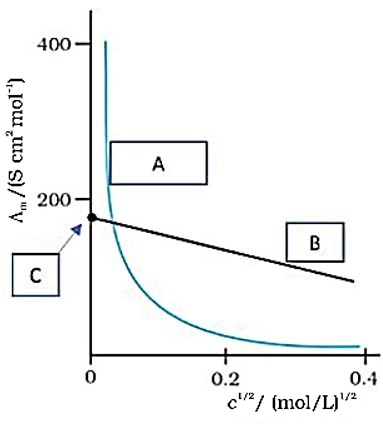
As shown on the y-axis of the provided graph, molar conductivity represents the conductivity of a solution containing one mole of electrolyte.
The formula is:
$\Lambda_m = \frac{\kappa \times 1000}{C}$
- $\kappa$ is in S/cm.
- $C$ (Concentration) is in $\text{mol/cm}^3$.
- This results in the unit: $\mathbf{S \text{ cm}^2 \text{mol}^{-1}}$.
Graph Analysis
The graph shows how molar conductivity ($\Lambda_m$) varies with the square root of concentration ($c^{1/2}$):
- Electrolyte A (Weak Electrolyte): Shows a steep increase in conductivity upon dilution.
- Electrolyte B (Strong Electrolyte): Shows a linear increase that can be extrapolated to point C, the limiting molar conductivity.
Correct Option:
S/cm, $\text{S cm}^2 \text{mol}^{-1}$