
Which of the following statements are correctly explaining the relationship between the marginal revenue (MR) and price elasticity of demand?
(A). Price elasticity is less than 1 when MR is negative.
(B). Price elasticity is more than 1 when MR is negative.
(C). Price elasticity is more than 1 when MR is positive.
(D). Price elasticity is less than 1 when MR is positive.
Choose the correct answer from the options given below:
Answer & explanation
Correct answer: option 4
The correct answer is Option (4) → (A) and (C) only
The relationship between Marginal Revenue (MR) and Price Elasticity of Demand can be understood by applying the Total Expenditure Method. In economics, the amount a consumer spends (Total Expenditure) is exactly the same as the money a seller receives (Total Revenue).
Relationship between Elasticity and Expenditure:
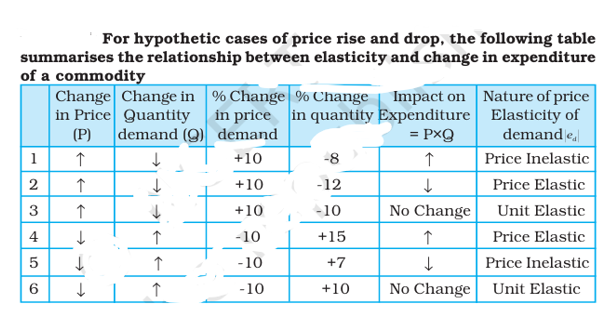
(A). Price elasticity is less than 1 when MR is negative. (Correct). As can be seen in Row 5 of the above table, when demand is inelastic ($|e_D| < 1$), a decrease in price leads to a decrease in Total Expenditure.
Conclusion: If you lower the price and your total collection (Revenue) goes down, it means the additional units sold lead to a fall in total revenue, implying negative marginal revenue. Therefore, MR is negative when elasticity is less than 1.
(B). Price elasticity is more than 1 when MR is negative. (Incorrect). When demand is elastic ($|e_D| > 1$), Row 4 states that price and expenditure move in opposite directions.
Conclusion: If a price fall leads to an increase in Total Expenditure (Row 4 in Table 2.5), it means the additional units sold increase total revenue, implying positive marginal revenue. This results in a positive MR, not a negative one.
(C). Price elasticity is more than 1 when MR is positive. (Correct). As per NCERT Table 2.5 (Row 4), when demand is elastic ($|e_D| > 1$), a price drop causes a rise in Total Expenditure.
Conclusion: Because the total money collected (Revenue) is increasing as more units are sold, the Marginal Revenue (MR) must be positive.
(D). Price elasticity is less than 1 when MR is positive. (Incorrect). For inelastic demand ($|e_D| < 1$), NCERT explains that expenditure moves in the same direction as price.
Conclusion : If you lower the price to sell more and your total revenue falls (Row 5 in Table 2.5), the marginal revenue is negative. It cannot be positive in this zone.
Note: The question is concept-based from the chapter Theory of Consumer Behaviour, particularly from the topics of demand, elasticity, and revenue behaviour. While the NCERT discusses these concepts and their interrelationship, the exact analytical relationship between Marginal Revenue (MR) and Price Elasticity of Demand is not directly stated in a formula-based manner in the textbook. Such concepts are often understood through classroom discussion, teacher explanation, practice questions, and conceptual application. Therefore, a student studying only the exact printed lines of NCERT may find this question slightly application-oriented. Therefore, the solution has been explained in detail by applying the concepts discussed in NCERT.