
CUETMOCK
  • Pricing
  • Mentors
Log inStart freeStart free mocks→

First test, then trust

Try a free CUET mock test.

Join 5,00,000+ students who rehearsed exam day on the exact NTA screen before sitting CUET. On the web and on Android.

Start free mocks →Get the Android app
CUETMOCK

India's #1 CUET Mock Test Platform. Original NCERT-based questions on the exact NTA exam screen — trusted by 5,00,000+ students since CUET 2022.

Get it onGoogle PlayScan to download the CUETMOCK app

Mock tests

  • CUET mock test series
  • Browse all papers
  • Commerce mocks
  • Humanities (Arts) mocks
  • Science mocks
  • Languages & GAT mocks
  • Free practice questions
  • Pricing

Resources

  • CUET exam guide
  • CUET syllabus
  • Universities accepting CUET
  • Expert blogs
  • News & notifications
  • Webinars & counselling
  • CUET score calculator
  • How we estimate your rank
  • FAQs

Company

  • About us
  • Our leadership & team
  • Our toppers
  • Mentors
  • For schools
  • Contact us
  • Terms
  • Privacy
  • Refund policy

Talk to us

+91 7696 6630 56info@cuetmock.comWhatsApp us

Our other platforms

  • JEE Mock — For IIT-JEE aspirants
  • NEET Mock — For NEET aspirants

Newsletter

Exam updates, study material and offers — no spam.

© 2026 NYC Ventures Pvt. Ltd.

701-702, Royal Business Park, Zirakpur, Punjab - 140603

  • Terms of use
  • Privacy policy
  • Refund policy
  • Contact us

iCUETMOCK is an independent preparation platform, not affiliated with the National Testing Agency (NTA). Always check exam details on the official NTA website.

  • Home
  • Mock tests
  • CUET guide
  • Pricing
  • Log in
Home/Practice questions/Physics
PhysicsElectric Charges and Fields

A point charge q is placed at the centre of the hemispherical surface…

A point charge q is placed at the centre of the hemispherical surface of radius R. The flux through the hemispherical surface is:
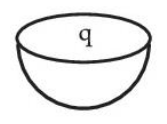
Figure for the question

Answer & explanation+

Correct answer: option 2

The correct answer is Option (2) → \( \displaystyle\frac{q}{2\varepsilon_0} \)

Complete the hemisphere into a full sphere of the same radius with the charge at its centre. By Gauss’s law the flux through the whole sphere is \( q/\varepsilon_0 \).

By symmetry the field is the same at every point of the sphere, so the flux divides equally between the two hemispheres.

    \( \displaystyle \phi_{\mathrm{hemisphere}} = \frac{1}{2}\times\frac{q}{\varepsilon_0} = \frac{q}{2\varepsilon_0} \)

Advertisement

Practise more on Electric Charges and Fields

Chapter-wise mocks on the real NTA exam screen, with solutions and your rank. Your first mocks are free.

Start free mocks →

Advertisement

Next questions

  1. The library expects you to return each and every book that you have _______.English · Fill Blanks
  2. If a : b : c = 2 : 3 : 5 and 5b - a + 2c = 115, then what is the value of b ?General Aptitude Test · Numerical Ability
  3. Which of the following is NOT a characteristic of Chordates?General Aptitude Test · General Knowledge
  4. Identify the alkane which on photochemical chlorination yields a single mono chloro product .Chemistry · Organic: Haloalkanes and Haloarenes
  5. Assertion: PERT (Programme Evaluation and Review Technique) and CPM (Critical Path Method) are important network techniques useful in plann…Business Studies · Controlling
  6. Match List A with List B List A List B (A) Second visit of Winnie was in (I) July 1966 (B) Winnie was constantly harassed since (II) 1964 (…English · Comprehension - (Narrative / Factual)
  7. Select the most appropriate meaning of the given idiom. To fight shy ofEnglish · Grammar: Idioms
  8. The average of 42 numbers is 37. The average of the first 26 numbers is 32, and the average of the last 17 numbers is 44. The 26th number i…General Aptitude Test · Numerical Ability
  9. In ΔABC, if tan A + tan B + tan C = 3√3, then the triangle is :Maths. Section B1 · Inverse Trigonometric Functions
  10. The value of the constant λ , so that the function given below is continuous at x=-1 is : f(x)= […]Maths. Section B1 · Continuity and Differentiability