
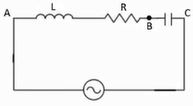
An LCR series circuit, with $L=\frac{2}{\pi}H, R = 100 Ω$ and $C =\frac{100}{\pi}μF$ is connected across a source of 200 V, 50 Hz as shown. The peak potential difference between A and B is:
Answer & explanation
Correct answer: option 2
The correct answer is Option (2) → $200\sqrt{5}V$
Given: $L=\frac{2}{\pi}\,\text{H},\;R=100\,\Omega,\;C=\frac{100}{\pi}\,\mu\text{F},\;V_{\text{rms}}=200\,\text{V},\;f=50\,\text{Hz}$.
Angular frequency: $\omega=2\pi f=100\pi\,\text{rad/s}$.
Reactances:
$X_L=\omega L=100\pi\cdot\frac{2}{\pi}=200\,\Omega$
$X_C=\frac{1}{\omega C}=\frac{1}{100\pi\cdot\frac{100}{\pi}\times10^{-6}}=100\,\Omega$
Circuit impedance magnitude:
$|Z|=\sqrt{R^2+(X_L-X_C)^2}=\sqrt{100^2+(200-100)^2}=\sqrt{100^2+100^2}=100\sqrt{2}\,\Omega$
RMS current: $I_{\text{rms}}=\frac{V_{\text{rms}}}{|Z|}=\frac{200}{100\sqrt{2}}=\frac{2}{\sqrt{2}}=\sqrt{2}\,\text{A}$.
Peak current: $I_0=\sqrt{2}\,I_{\text{rms}}=2\,\text{A}$.
Impedance of $L$ and $R$ together: $|Z_{LR}|=\sqrt{R^2+X_L^2}=\sqrt{100^2+200^2}=100\sqrt{5}\,\Omega$.
Peak potential between A and B: $V_{AB,0}=I_0\,|Z_{LR}|=2\times 100\sqrt{5}=200\sqrt{5}\,\text{V}$
Answer: $200\sqrt{5}\ \text{V}$