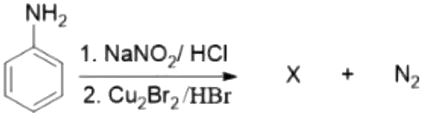
The product (X) in the following reaction is
Answer & explanation
Correct answer: option 2
The correct answer is Option (2) → bromobenzene (\( \ce{C6H5Br} \))
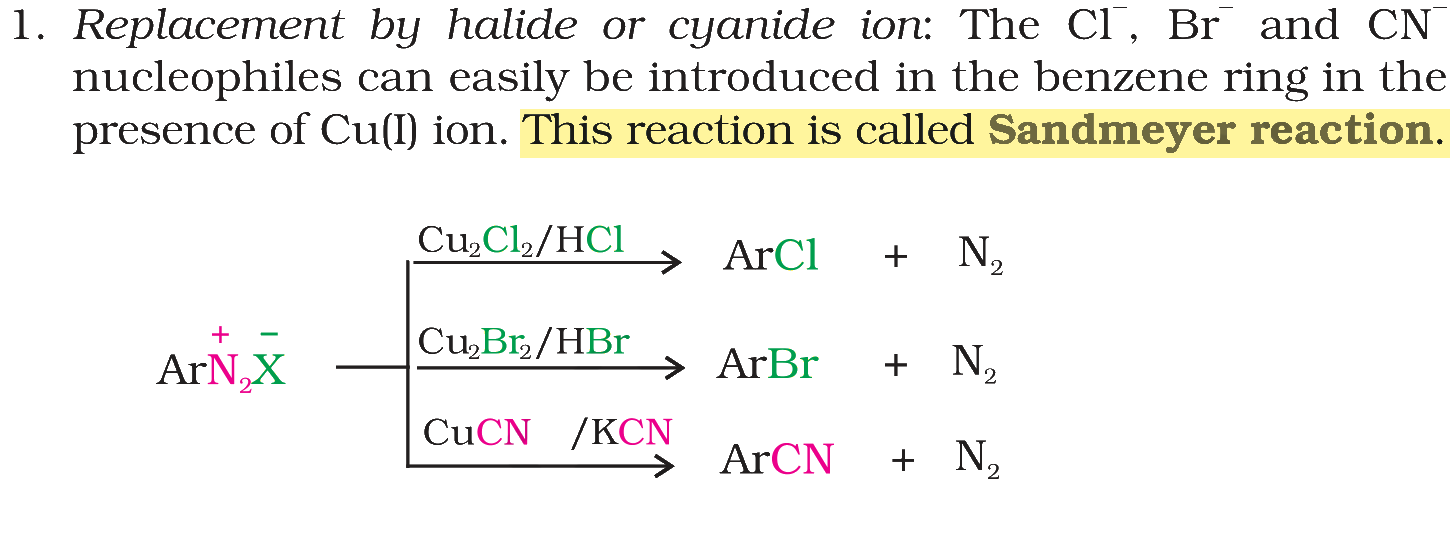
A primary aromatic amine is first converted into a diazonium salt with nitrous acid at 273–278 K (diazotisation). The \( \ce{-N2+} \) group is a very good leaving group: with cuprous chloride or cuprous bromide it is replaced by \( \ce{-Cl} \) or \( \ce{-Br} \) and nitrogen gas escapes. This replacement with Cu(I) is the Sandmeyer reaction.
Aniline is diazotised by \( \ce{NaNO2} \) and HCl:
\( \displaystyle \ce{C6H5NH2 + NaNO2 + 2HCl} \xrightarrow{\text{273-278 K}} \ce{C6H5N2+Cl- + NaCl + 2H2O} \)
The benzenediazonium chloride then reacts with \( \ce{Cu2Br2} \) in HBr:
\( \displaystyle \ce{C6H5N2+Cl-} \xrightarrow{\ce{Cu2Br2}/\ce{HBr}} \ce{C6H5Br + N2 ^} \)
So X is bromobenzene, formed together with \( \ce{N2} \).
Why the other options are incorrect
Option (1) aniline (\( \ce{C6H5NH2} \)) — Incorrect. This is the starting material; the \( \ce{-NH2} \) group is lost as \( \ce{N2} \) in the reaction.
Option (3) benzoic acid (\( \ce{C6H5COOH} \)) — Incorrect. It would need \( \ce{Cu2(CN)2} \)/KCN to give benzonitrile, followed by hydrolysis of the –CN group.
Option (4) benzene (\( \ce{C6H6} \)) — Incorrect. The diazonium group is replaced by H only with a mild reducing agent such as hypophosphorous acid, \( \ce{H3PO2} \), or ethanol.
NCERT (2026-27 edition):
Replacement by Halide or Cyanide Ion