
A particle of mass m is kept on the axis of a fixed circular ring of mass M and radius R at a distance x from the centre of the ring. If x << R, At what value of x the force between the ring and the particle is maximum:
Answer & explanation
Correct answer: option 1
We see from the figure that, each portion of the ring having a mass $\delta m$ attracts the particle towards itself with a force $\delta F$ given as $\delta F=\frac{G(\delta m) m}{r^2}$
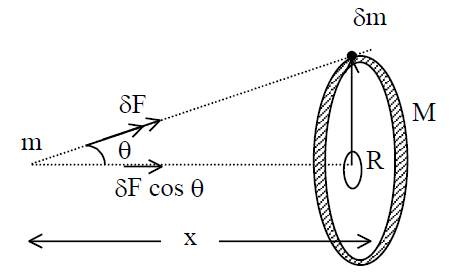
$\Rightarrow$ The axial component of this force $=\delta F_x=\delta F Cos \theta=\frac{G(\delta m) m}{r^2} . \frac{x}{r} =\frac{G m x}{r^3}(\delta m)$
$\Rightarrow$ The total axial force experienced by the particle due to the whole ring
$F_x=\sum \delta F_x=\int d F_x \quad \Rightarrow \quad F_x=\frac{G m x}{r^3} \int\limits_0^M \delta m$
$\Rightarrow F_x=\frac{G M m x}{\left(R^2+x^2\right)^{3 / 2}}$ .......(1)
(since r = $\sqrt{R^2+x^2}$)
For $F_x$ to be maximum
$\frac{dF_{x}}{dx}=0 \text { and } \frac{d^2 F_{x}}{dx}<0$
Using (1),
$\frac{dF_{x}}{dx}=GM \frac{d}{dx}\left\{\frac{x}{\left(R^2+x^2\right)^{3 / 2}}\right\}$
$=G M {\frac{\left(R^2+x^2\right)^{3 / 2}-x \frac{3}{2}\left(R^2+x^2\right)^{1 / 2}(2 x)}{\left(R^2+x^2\right)^3}}$
Setting $\frac{d F_x}{d x}=0$ and simplifying the factors, we obtain, $x=\frac{R}{\sqrt{2}}$