
Read the passage carefully and answer the questions.
Amines are considered to be derivatives of ammonia obtained by replacement of hydrogen atoms with alkyl or aryl groups. They are usually prepared from nitro compounds, halides, amides, imides etc. The presence of hydrogen bonding influences its physical properties. In alkylamines, a combination of electron releasing steric and hydrogen bonding factors influences the stability of substituted ammonium cations in protic polar solvents and thus affects the basic nature of amines. Alkyl amines are found to be stronger bases than ammonia which is more basic than water. Primary and secondary amines are engaged in intermolecular association due to hydrogen bonding. This intermolecular association is more in primary amines than in secondary amines. Tertiary amines do not have intermoleulcar association due to the absence of hydrogen atom available for hydrogen bonding. Thus, the boiling point of amines depends on hydrogen bonding. In aromatic amines, electron releasing and withdrawing groups increase and decrease their basic character. Aryl diazonium salts usually obtained from arylamine undergo replacement of the diazonium group with a variety of nucleophile. Their coupling reaction of aryl diazonium salts with phenol or arylamine results in formation of dyes.
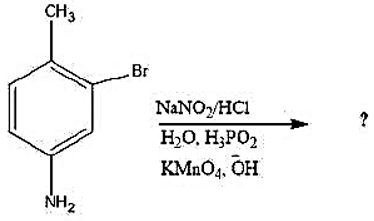
Complete the following reaction:
Answer & explanation
Correct answer: option 2
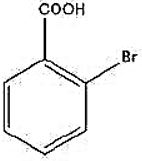
The correct answer is Option (2) →
1. Initial Reactant: 2-bromo-4-methylaniline
2. Step 1: Diazotization and Deamination
The ${--NH}_2$ group is replaced by H.
Intermediate: 2-bromo-4-methylbenzene
3. Step 2: Oxidation
The ${--CH}_3$ group is oxidized to ${--COOH}$.
Under harsh basic $(\text{OH}^{-})$ and oxidizing $(\text{KMnO}_4)$ conditions, the Br atom is typically cleaved from the ring.
4. Final Product: 4-methylbenzoic acid (p-toluic acid)