
CUETMOCK
  • Pricing
  • Mentors
Log inStart freeStart free mocks→

First test, then trust

Try a free CUET mock test.

Join 5,00,000+ students who rehearsed exam day on the exact NTA screen before sitting CUET. On the web and on Android.

Start free mocks →Get the Android app
CUETMOCK

India's #1 CUET Mock Test Platform. Original NCERT-based questions on the exact NTA exam screen — trusted by 5,00,000+ students since CUET 2022.

Get it onGoogle PlayScan to download the CUETMOCK app

Mock tests

  • CUET mock test series
  • Browse all papers
  • Commerce mocks
  • Humanities (Arts) mocks
  • Science mocks
  • Languages & GAT mocks
  • Free practice questions
  • Pricing

Resources

  • CUET exam guide
  • CUET syllabus
  • Universities accepting CUET
  • Expert blogs
  • News & notifications
  • Webinars & counselling
  • CUET score calculator
  • How we estimate your rank
  • FAQs

Company

  • About us
  • Our leadership & team
  • Our toppers
  • Mentors
  • For schools
  • Contact us
  • Terms
  • Privacy
  • Refund policy

Talk to us

+91 7696 6630 56info@cuetmock.comWhatsApp us

Our other platforms

  • JEE Mock — For IIT-JEE aspirants
  • NEET Mock — For NEET aspirants

Newsletter

Exam updates, study material and offers — no spam.

© 2026 NYC Ventures Pvt. Ltd.

701-702, Royal Business Park, Zirakpur, Punjab - 140603

  • Terms of use
  • Privacy policy
  • Refund policy
  • Contact us

iCUETMOCK is an independent preparation platform, not affiliated with the National Testing Agency (NTA). Always check exam details on the official NTA website.

  • Home
  • Mock tests
  • CUET guide
  • Pricing
  • Log in
Home/Practice questions/Chemistry
ChemistryOrganic: Haloalkanes and Haloarenes

The order of kinetics of S_N1 reactions is:

The order of kinetics of \( S_{N}1 \) reactions is:

Answer & explanation+

Correct answer: option 1

The correct answer is Option (1) → First

An \(S_N1\) reaction (substitution, nucleophilic, unimolecular) takes place in two steps. In the first, slow step the C–X bond breaks and a carbocation is formed; in the second, fast step the nucleophile attacks the carbocation. For tert-butyl bromide and hydroxide ion:

    \( \displaystyle \ce{(CH3)3C-Br} \xrightarrow{\text{slow}} \ce{(CH3)3C+ + Br^-} \)

    \( \displaystyle \ce{(CH3)3C+ + OH^-} \xrightarrow{\text{fast}} \ce{(CH3)3C-OH} \)

The rate is decided by the slow step, which involves only the alkyl halide:

    \( \displaystyle \text{Rate} = k[\ce{(CH3)3CBr}] \)

This is first order kinetics. In an \( \mathrm{S_N2} \) reaction, by contrast, the nucleophile attacks in the same single step in which the halide leaves, so the rate is second order, Rate = k[RX][Nu−].

NCERT (2026-27 edition):
Substitution Nucleophilic Unimolecular (SN1)
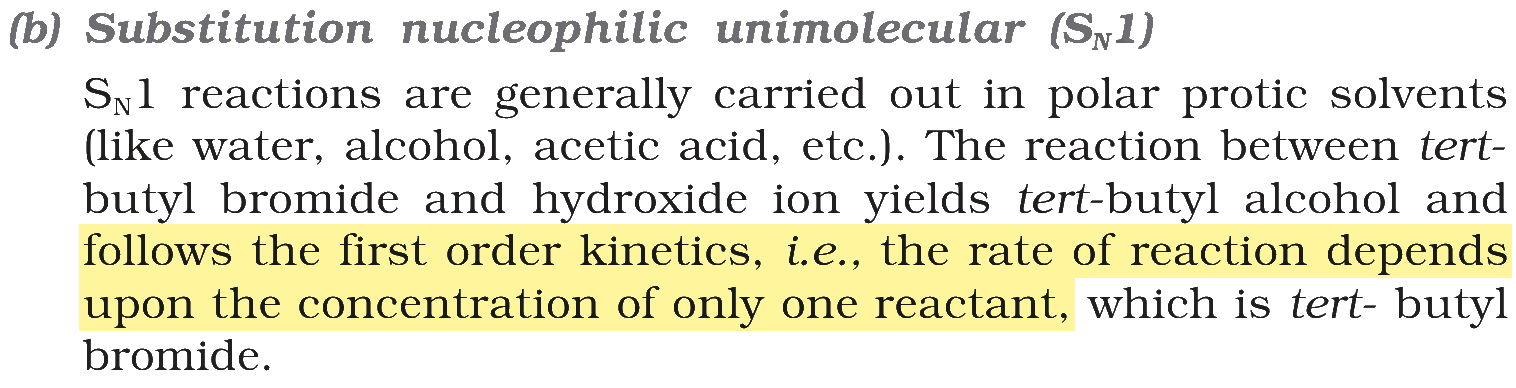
Textbook extract

Advertisement

Practise more on Organic: Haloalkanes and Haloarenes

Chapter-wise mocks on the real NTA exam screen, with solutions and your rank. Your first mocks are free.

Start free mocks →

Advertisement

Next questions

  1. If x4 + 1/(x^4) = 37634 , the positive value of x + 1/x is?General Aptitude Test · Quantitative Reasoning
  2. In what time does a sum of money amount to twice of itself at simple interest of 10% per annum?General Aptitude Test · Numerical Ability
  3. In a school there are total 414 students. The ratio of boys and girls is 5 : 4. If 46 more boys gets admitted into the school, then what wi…General Aptitude Test · Numerical Ability
  4. What role did the member on the first stall serve in the making of the Constitution?History · Modern India: Framing the Constitution
  5. Select the most appropriate synonym of the given word. CONCRETEEnglish · Synonyms
  6. Binding energy of a nucleus isPhysics · Nuclei
  7. Who is responsible for providing safe, efficient air traffic and aeronautical communication services in the Indian Air Space?Geography · India-People and Economy: Transport and Communcation
  8. In 1838, who published an article discussing the structure and origin of plant cells?General Aptitude Test · General Knowledge
  9. Study of an industry is an example of:Economics · Micro Economics: Introduction
  10. Inscriptions are writings engraved on which of the following?History · Ancient India: Kings, Farmers and Towns