
CUETMOCK
  • Pricing
  • Mentors
Log inStart freeStart free mocks→

First test, then trust

Try a free CUET mock test.

Join 5,00,000+ students who rehearsed exam day on the exact NTA screen before sitting CUET. On the web and on Android.

Start free mocks →Get the Android app
CUETMOCK

India's #1 CUET Mock Test Platform. Original NCERT-based questions on the exact NTA exam screen — trusted by 5,00,000+ students since CUET 2022.

Get it onGoogle PlayScan to download the CUETMOCK app

Mock tests

  • CUET mock test series
  • Browse all papers
  • Commerce mocks
  • Humanities (Arts) mocks
  • Science mocks
  • Languages & GAT mocks
  • Free practice questions
  • Pricing

Resources

  • CUET exam guide
  • CUET syllabus
  • Universities accepting CUET
  • Expert blogs
  • News & notifications
  • Webinars & counselling
  • CUET score calculator
  • How we estimate your rank
  • FAQs

Company

  • About us
  • Our leadership & team
  • Our toppers
  • Mentors
  • For schools
  • Contact us
  • Terms
  • Privacy
  • Refund policy

Talk to us

+91 7696 6630 56info@cuetmock.comWhatsApp us

Our other platforms

  • JEE Mock — For IIT-JEE aspirants
  • NEET Mock — For NEET aspirants

Newsletter

Exam updates, study material and offers — no spam.

© 2026 NYC Ventures Pvt. Ltd.

701-702, Royal Business Park, Zirakpur, Punjab - 140603

  • Terms of use
  • Privacy policy
  • Refund policy
  • Contact us

iCUETMOCK is an independent preparation platform, not affiliated with the National Testing Agency (NTA). Always check exam details on the official NTA website.

  • Home
  • Mock tests
  • CUET guide
  • Pricing
  • Log in
Home/Practice questions/Physics
PhysicsCurrent Electricity

If three cells are connected in parallel as shown in figure, then equ…

If three cells are connected in parallel as shown in figure, then equivalent emf would be:
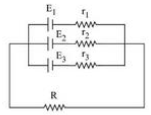
Figure for the question

Answer & explanation+

Correct answer: option 3

The correct answer is Option (3) → \( E_{eq} = \displaystyle\sum_{i=1}^{3} E_i/r_i \Big/ \sum_{i=1}^{3} 1/r_i \)

The three cells (emf \( E_i \), internal resistance \( r_i \)) are joined in parallel, so they share the same terminal voltage \( V \) across the external resistor R. Apply Kirchhoff's junction rule to the currents of the cells.

The current given by cell \( i \) is

    \( \displaystyle I_i = \frac{E_i - V}{r_i} \)

Adding the three currents gives the current \( I \) through R:

    \( \displaystyle I = \sum_{i=1}^{3}\frac{E_i}{r_i} - V\sum_{i=1}^{3}\frac{1}{r_i} \)

Rearranging into the form \( V = E_{eq} - I\,r_{eq} \) of a single cell:

    \( \displaystyle V = \frac{\sum E_i/r_i}{\sum 1/r_i} - I\,\frac{1}{\sum 1/r_i} \)

So the combination acts as one cell with

    \( \displaystyle E_{eq} = \frac{\sum_{i=1}^{3} E_i/r_i}{\sum_{i=1}^{3} 1/r_i} \qquad \frac{1}{r_{eq}} = \sum_{i=1}^{3}\frac{1}{r_i} \)

NCERT (2026-27):
Cells – “… Equations (3.56) and (3.57) can be extended easily. If there are n cells of emf ε1, . . . εn and of internal resistances r1,.... rn respectively, connected in parallel, the combination is equivalent to a single cell of emf εeq and internal resistance req, such that

    \( \displaystyle \frac{1}{r_{eq}} = \frac{1}{r_1} + \ldots + \frac{1}{r_n} \qquad (3.58) \)

    \( \displaystyle \frac{\varepsilon_{eq}}{r_{eq}} = \frac{\varepsilon_1}{r_1} + \ldots + \frac{\varepsilon_n}{r_n} \qquad (3.59) \) ”

Advertisement

Practise more on Current Electricity

Chapter-wise mocks on the real NTA exam screen, with solutions and your rank. Your first mocks are free.

Start free mocks →

Advertisement

Next questions

  1. Choose the word from the following that has a similar meaning as "faculty". A. facilityB. abilityC. privilegeD. desireChoose the correct an…English · Comprehension - (Narrative / Factual)
  2. This key combination collapses the ribbon.Accountancy Part C · Spreadsheet
  3. Which of the following is NOT a financial sector regulator in India?Economics · Macro Economics: Money and Banking
  4. Sahibdin painted the Yuddha Kanda of the Ramayana at Mewar in 1652. Consider the following statements on this work:(A) It uses oblique aeri…Fine Arts · The Rajasthani Schools of Painting
  5. Pick the odd one out:Geography · India-People and Economy: Transport and Communcation
  6. Study the given graph and answer one questions that follows. Degree wise distribution of no. of students working in Class (A, B, C, D and E…General Aptitude Test · Quantitative Reasoning
  7. What will come in place of the question mark (?) in the following number series? 7, 10, 16, 25, 37, ?General Aptitude Test · Verbal Reasoning
  8. निम्नलिखित में से कौन रीतिकाल के कवि नहीं हैं?Hindi · हिंदी साहित्य (रचना, रचनाकार और विधाएँ)
  9. Which of the following is used in making automobile tyres and footwear?Chemistry · Organic: Polymers
  10. In India, how is the sex ratio of the population expressed?General Aptitude Test · General Knowledge