Read the following passage carefully.
MONOHYBRID CROSS
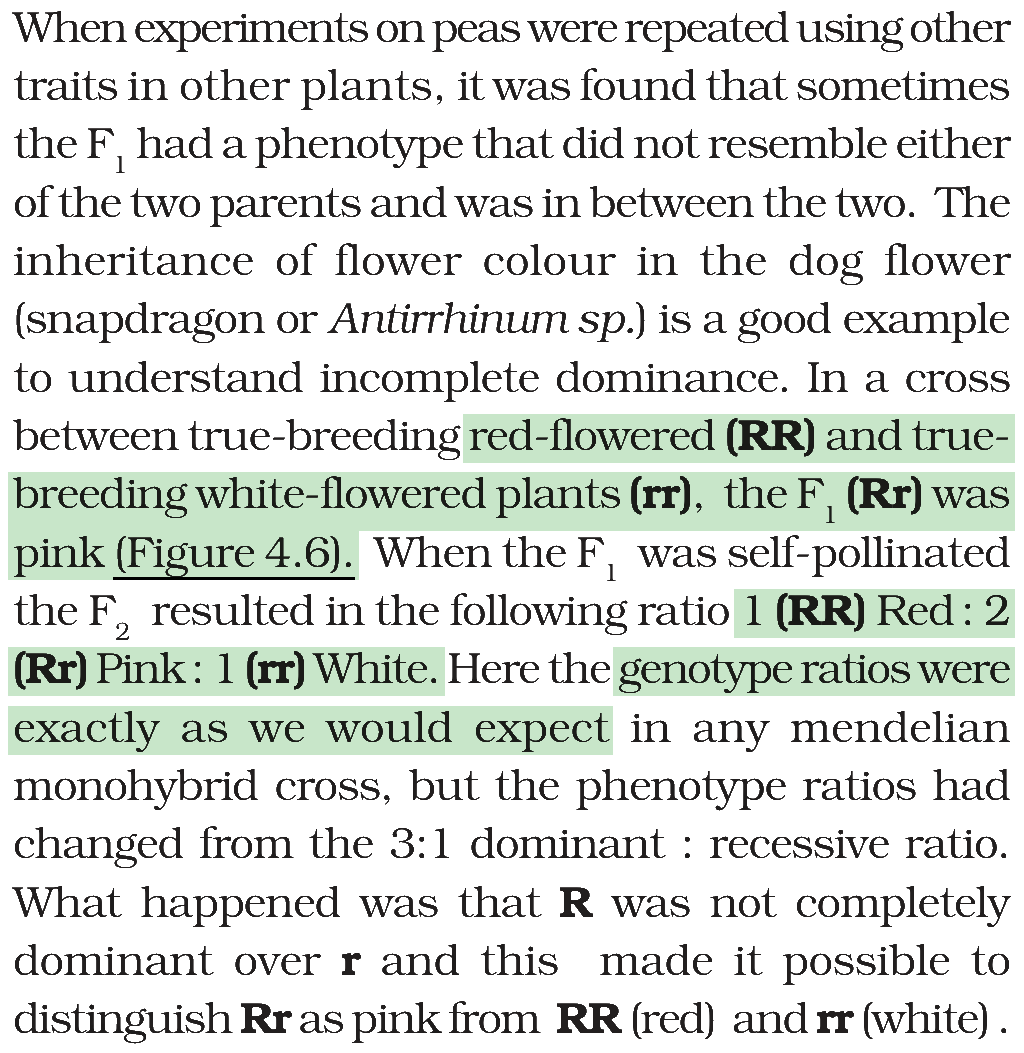
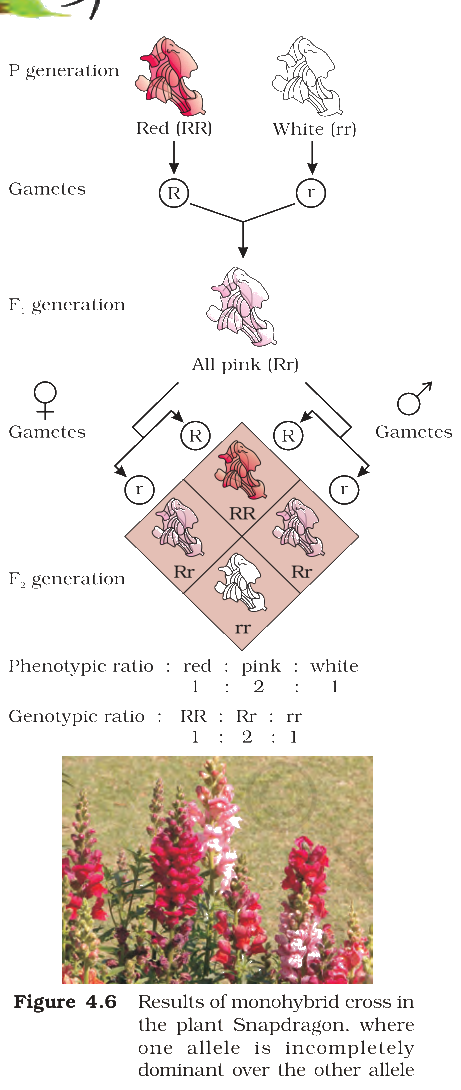
The inheritance of flower color in the dog flower (Snapdragon or Antirrhinum sp.) can be understood by crossbreeding between true-breeding red-flowered (RR) and true-breeding white-flowered plants (rr). When they were crossed, \( F_1 \) (Rr) was pink. When \( F_1 \) was self-pollinated, the \( F_2 \) results were Red, Pink and White. Here the genotype ratios were exactly as expected, but the phenotype ratios have been changed. What happened was that R was not completely dominant over r and this made it possible to distinguish Rr as pink from RR (Red) and rr (White).
What will be the genotypic ratio in \( F_2 \) generation when \( F_1 \) (Rr) was self-pollinated?
Answer & explanation
Correct answer: option 4
The correct answer is Option (4) → 1 : 2 : 1
The genotypic ratio counts the allele combinations, not the colours. Selfing Rr gives RR, Rr, Rr and rr, so the F2 genotypes are 1 RR : 2 Rr : 1 rr. This is the same in every monohybrid cross, whatever the type of dominance.
Option (1) 3 : 1 — Incorrect. 3 : 1 is a phenotypic ratio under complete dominance. It joins RR and Rr into one class, so it cannot be a genotypic ratio.
Option (2) 2 : 1 : 1 — Incorrect. It puts the larger number on a homozygote. The heterozygote Rr is the class that is formed twice, so the 2 belongs in the middle.
Option (3) 1 : 1 — Incorrect. A 1 : 1 genotypic ratio (Rr : rr) comes from a test cross, not from selfing.
Option (4) 1 : 2 : 1 — Correct. One RR, two Rr and one rr: the genotype ratio is the one expected in any monohybrid cross.
Note: The passage is taken from NCERT. NTA has put lines of the NCERT text together to make it. Most CUET (UG) questions come straight from NCERT, so study the book line by line, including figures and their titles.
NCERT Extract:
Incomplete Dominance –