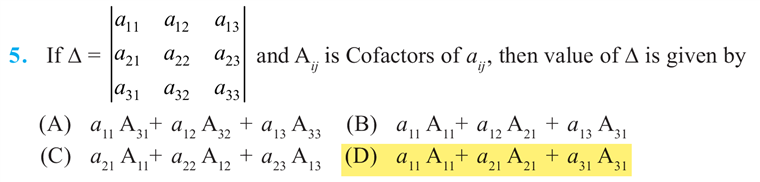
If \(\Delta=\begin{vmatrix}a_{11} & a_{12} & a_{13}\\a_{21} & a_{22} & a_{23}\\a_{31} & a_{32} & a_{33}\end{vmatrix}\) and \(A_{ij}\) is the cofactor of \(a_{ij}\), then the value of \(\Delta\) is given by:
Answer & explanation
Correct answer: option 4
The correct answer is Option (4) → \(a_{11}A_{11}+a_{21}A_{21}+a_{31}A_{31}\)
A determinant equals the sum of the products of the elements of any one row or column with their own cofactors.
Expanding along the first column:
\(\Delta = a_{11}A_{11} + a_{21}A_{21} + a_{31}A_{31}\)
This is Option (4).
Why the other options are incorrect
Option (1) \(a_{11}A_{31}+a_{12}A_{32}+a_{13}A_{33}\) — Incorrect. Elements of the first row with cofactors of the third row: such a sum is always 0.
Option (2) \(a_{11}A_{11}+a_{12}A_{21}+a_{13}A_{31}\) — Incorrect. Elements of the first row with cofactors of the first column: this is not an expansion along any row or column, so it is not \(\Delta\) in general.
Option (3) \(a_{21}A_{11}+a_{22}A_{12}+a_{23}A_{13}\) — Incorrect. Elements of the second row with cofactors of the first row: such a sum is always 0.
NCERT (2026-27 edition):
Minors and Cofactors