How does the osmotic pressure of a solution vary with the temperature?
Answer & explanation
Correct answer: option 3
The correct answer is Option (3) → increases with increase in temperature
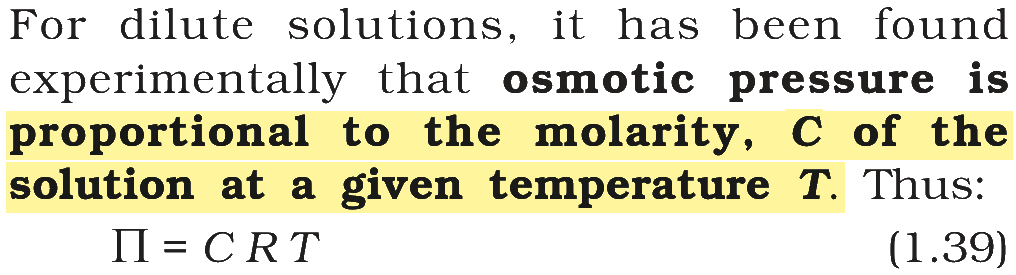
Osmotic pressure is the extra pressure that must be applied on a solution to stop the flow of solvent into it through a semipermeable membrane. For a dilute solution it obeys the van’t Hoff equation, which has the same form as the ideal gas equation:
\( \displaystyle \Pi = C\,R\,T = \frac{n}{V}\,R\,T \)
For a given solution, the molar concentration C and the gas constant R are fixed, so
\( \displaystyle \Pi \propto T \)
The osmotic pressure is directly proportional to the absolute temperature, so it increases with increase in temperature. For example, if the temperature of a solution rises from 300 K to 330 K, its osmotic pressure rises by the factor 330/300 = 1.1.
NCERT (2026-27 edition):
Osmosis and Osmotic Pressure – …