
Match List-I with List-II
| List-I | List-II | ||
|---|---|---|---|
| (Shapes) | (Area/Perimeter/Diagonal/slant height) | ||
| (A) | Trapezium | (I) | \(\sqrt{l^2+b^2+h^2}\) |
| (B) | Sector of a circle | (II) | \(\sqrt{h^2+(R-r)^2}\) |
| (C) | Cuboid | (III) | \(\displaystyle\frac{1}{2}h(a+b)\) |
| (D) | Frustum of cone | (IV) | \(\left(\displaystyle\frac{\theta}{360^\circ}\right)\times2\pi r\) |
Choose the correct answer from the options given below:
Answer & explanation
Correct answer: option 3
The correct answer is Option (3) → (A)-(III), (B)-(IV), (C)-(I), (D)-(II)
Each formula in List-II is read for the shape it belongs to: what each letter stands for tells which figure it describes.
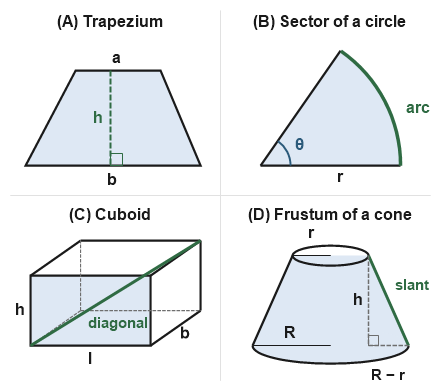
(A) Trapezium — this matches (III) \(\frac{1}{2}h(a+b)\). The area of a trapezium is half the sum of the parallel sides \(a\) and \(b\) times the distance \(h\) between them.
(B) Sector of a circle — this matches (IV) \(\left(\frac{\theta}{360^\circ}\right)\times2\pi r\). A sector with angle \(\theta\) takes \(\frac{\theta}{360^\circ}\) of the whole circle, so this is the length of its arc, the curved part of its perimeter.
(C) Cuboid — this matches (I) \(\sqrt{l^2+b^2+h^2}\). It is the diagonal of a cuboid of length \(l\), breadth \(b\) and height \(h\), found by applying Pythagoras’ theorem twice.
(D) Frustum of cone — this matches (II) \(\sqrt{h^2+(R-r)^2}\). It is the slant height of a frustum with height \(h\) and end radii \(R\) and \(r\): the slant side is the hypotenuse of a right triangle with sides \(h\) and \(R-r\).