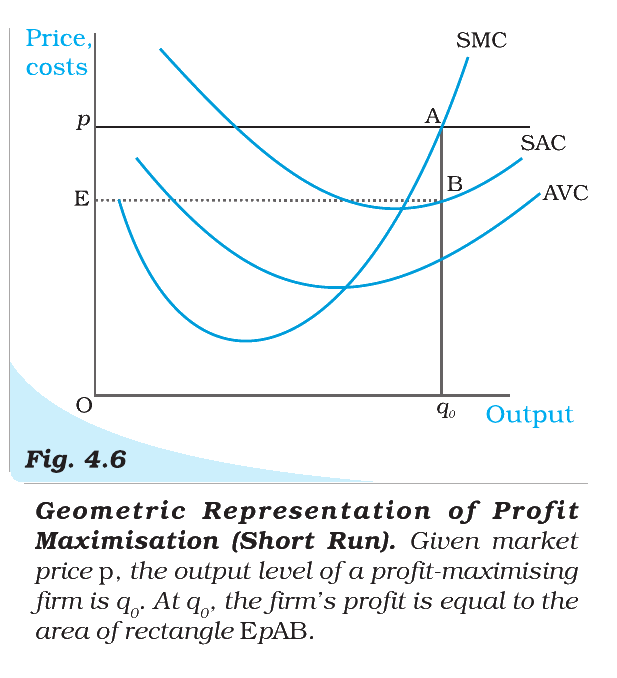
Given diagram is a Geometric Representation of Profit Maximisation (Short Run). Study the diagram given below and answer the question.
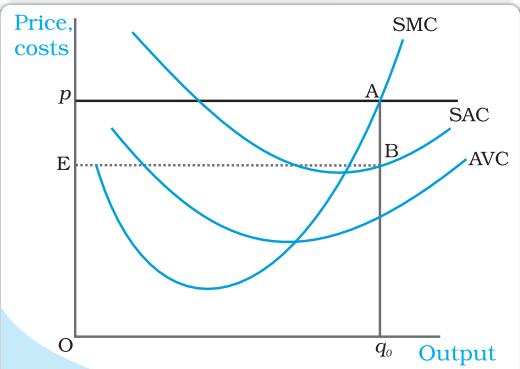
What is the total cost of the firm at output q0?
Answer & explanation
Correct answer: option 1
The correct answer is Option (1) → The area of rectangle OEBq0
Total cost = average cost × quantity. At q0, short run average cost is the height Bq0 (= OE) and quantity is Oq0. Their product is the area of rectangle OEBq0.
Option (1) The area of rectangle OEBq0 — Correct. Average cost OE times output Oq0.
Option (2) The area of rectangle OpAq0 — Incorrect. This is total revenue, price times quantity.
Option (3) The area of rectangle EpAB — Incorrect. This is the profit, TR minus TC.
Option (4) The vertical distance Bq0 — Incorrect. This is the average cost of one unit.
NCERT (2026-27): “4.3.4 The Profit Maximisation Problem: Graphical Representation … Consider Figure 4.6. Notice that the market price is p. Equating the market price with the (short run) marginal cost, we obtain the output level q0. At q0, observe that SMC slopes upwards and p exceeds AVC. Since the three conditions discussed in sections 3.1-3.3 are satisfied at q0, we maintain that the profit-maximising output level of the firm is q0. … The total revenue of the firm at q0 is the area of rectangle OpAq0 (the product of price and quantity) while the total cost at q0 is the area of rectangle OEBq0 (the product of short run average cost and quantity). So, at q0, the firm earns a profit equal to the area of the rectangle EpAB.”
|