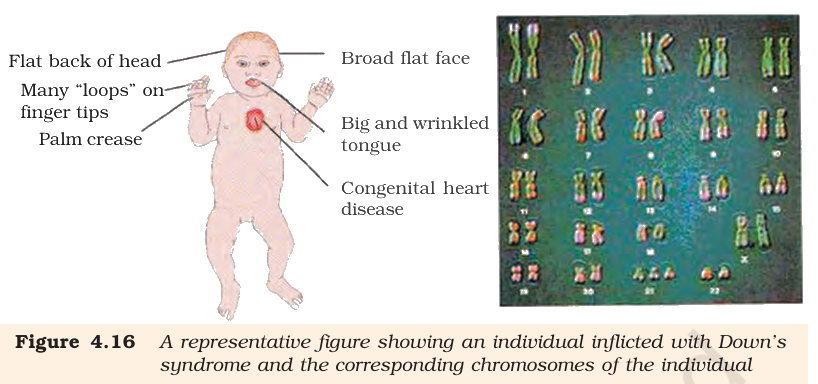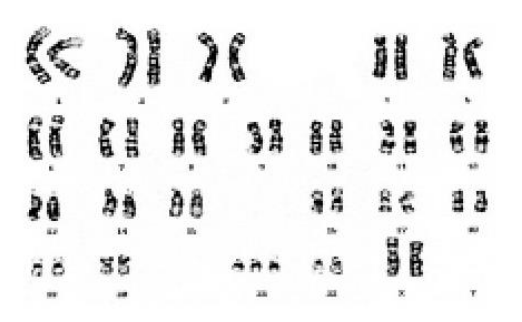
The chromosomal disorders are caused due to absence, excess or abnormal arrangement of one or more chromosomes. Failure of segregation of chromatids during cell division results in the gain or loss of chromosome(s), called aneuploidy.
The disorder shown in the figure is caused due to:
Answer & explanation
Correct answer: option 4
The correct answer is Option (4) → Gain of an autosome
Option (1) Gain of extra 'X' chromosome — Incorrect. An extra X chromosome (XXY) causes Klinefelter’s syndrome, a disorder of the sex chromosomes. Down’s syndrome involves an autosome, chromosome 21.
Option (2) Loss of 'Y' chromosome — Incorrect. Loss of a sex chromosome gives disorders like Turner’s syndrome (X0), from loss of an X. Down’s syndrome is caused by a gain, not a loss, and of an autosome, not a sex chromosome.
Option (3) Loss of an autosome — Incorrect. In Down’s syndrome an autosome is gained, not lost: there is an extra copy of chromosome 21, giving 47 chromosomes.
Option (4) Gain of an autosome — Correct. The karyotype shows three copies of chromosome 21. Chromosome 21 is an autosome, so the disorder (Down’s syndrome) is caused by the gain of an autosome, an example of aneuploidy.
NCERT Extract:
Chromosomal Disorders – “… Down’s Syndrome : The cause of this genetic disorder is the presence of an additional copy of the chromosome number 21 (trisomy of 21). This disorder was first described by Langdon Down (1866). The affected individual is short statured with small round head, furrowed tongue and partially open mouth (Figure 4.16). Palm is broad with characteristic palm crease. Physical, psychomotor and mental development is retarded.”