For a hypothetical firm, the total cost of producing 5 units of a commodity is Rs. 310 and that of producing 8 units is Rs. 850. If the firm has to spend Rs. 50 even when there is no output, what will be the marginal cost of producing the 8th unit?
Answer & explanation
Correct answer: option 2
The correct answer is Option (2) → Rs. 180
Given:
Total cost of 5 units, TC5 = Rs. 310
Total cost of 8 units, TC8 = Rs. 850
Cost at zero output, which is the total fixed cost, TFC = Rs. 50
Marginal cost (MC) is the change in total cost per unit change in output. The fixed cost is the same at every output, so it has no effect on marginal cost:
Change in total cost, ΔTC = 850 − 310 = Rs. 540
Change in output, Δq = 8 − 5 = 3 units
MC = \( \displaystyle \frac{\Delta TC}{\Delta q} = \frac{540}{3} \) = Rs. 180
Rs. 540 is the extra cost of all three units together, not the cost per unit.
Note: The figures cover three units (the 6th, 7th and 8th), so Rs. 180 is the average marginal cost of these three units. The marginal cost of the 8th unit alone needs the total cost of 7 units, which is not given in the question.
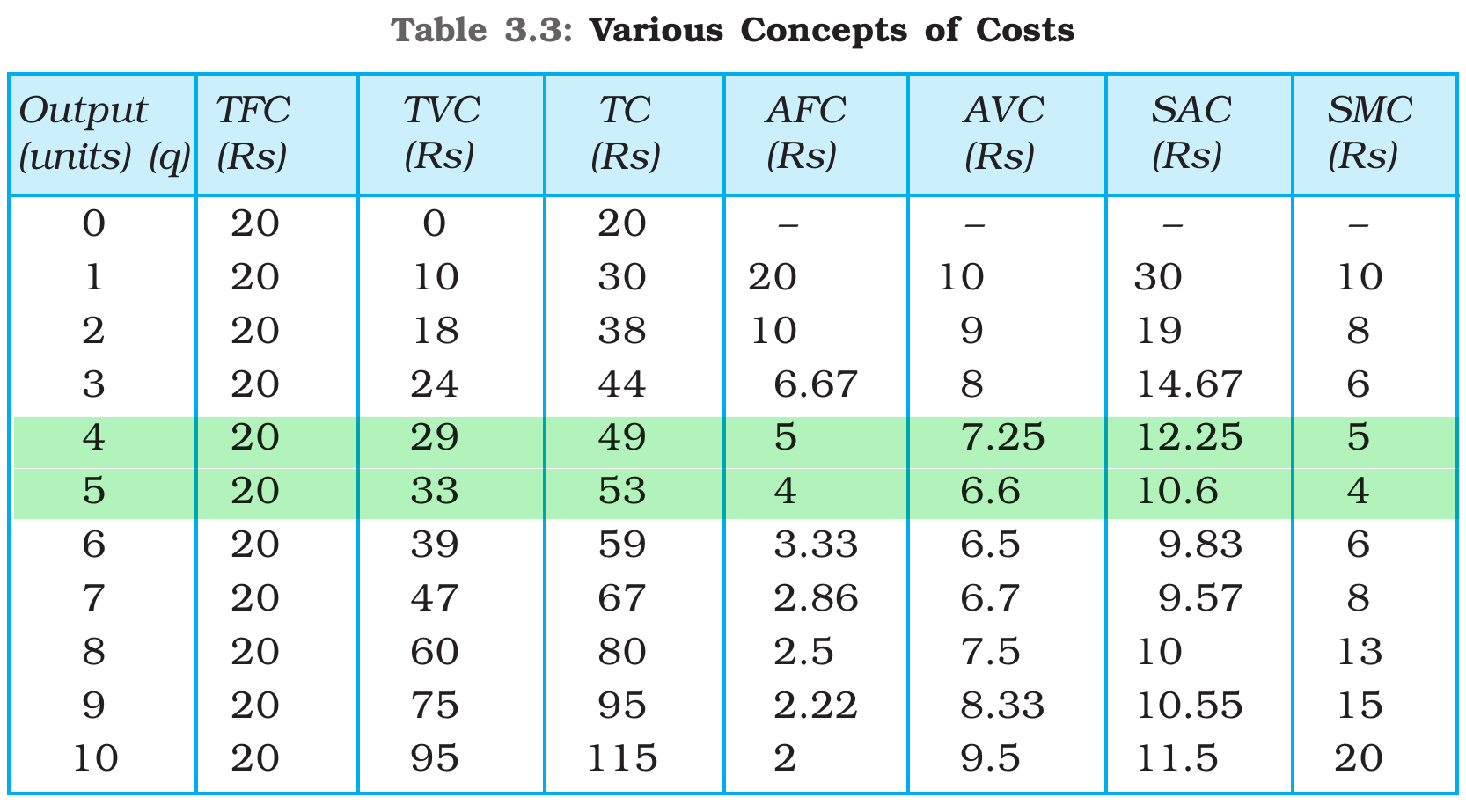
NCERT (2026-27): “3.7.1 Short Run Costs … In the short run, some of the factors of production cannot be varied, and therefore, remain fixed. The cost that a firm incurs to employ these fixed inputs is called the total fixed cost (TFC). Whatever amount of output the firm produces, this cost remains fixed for the firm. To produce any required level of output, the firm, in the short run, can adjust only variable inputs. Accordingly, the cost that a firm incurs to employ these variable inputs is called the total variable cost (TVC). Adding the fixed and the variable costs, we get the total cost (TC) of a firm TC = TVC + TFC… The short run marginal cost (SMC) is defined as the change in total cost per unit of change in output… The last column in table 3.3 gives a numerical example for the calculation of SMC. Values in this column are obtained by dividing the change in TC by the change in output, at each level of output. Thus at q=5, Change in TC = (TC at q=5) - (TC at q=4) (3.12) = (53) – (49) = 4 Change in q = 1 SMC = 4/1 = 4”
|