
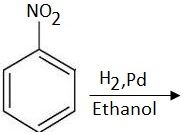
Reduction of nitrobenzene gives
Answer & explanation
Correct answer: option 2
The correct answer is Option (2) → Aniline
Nitro compounds are reduced to amines by passing hydrogen gas in the presence of a finely divided metal catalyst (Ni, Pd or Pt), or by a metal with acid. The nitro group \( \ce{-NO2} \) is converted to the amino group \( \ce{-NH2} \), and the oxygen atoms leave as water. Ethanol is only the solvent:
\( \displaystyle \ce{C6H5NO2 + 3H2} \xrightarrow[\text{ethanol}]{\ce{H2},\ \ce{Pd}} \ce{C6H5NH2 + 2H2O} \)
So the product is aniline (benzenamine).
Why the other options are incorrect
Option (1) Nitrotoluene — Incorrect. It has an extra methyl group; it is made by nitrating toluene, and hydrogen cannot add a carbon atom.
Option (3) Benzoic acid — Incorrect. It is obtained by oxidising toluene, for example with alkaline \( \ce{KMnO4} \); reduction of nitrobenzene does not introduce a carboxyl group.
Option (4) Benzene — Incorrect. Reduction converts the nitro group into an amino group; it does not remove the nitrogen from the ring.
NCERT (2026-27 edition):
Reduction of Nitro Compounds
