Match List-I with List-II
|
List-I Type of solution |
List-II Example |
|
(A) solid in solid |
(I) Camphor in \( N_2 \) |
|
(B) solid in gas |
(II) Cu in Au |
|
(C) gas in solid |
(III) Hg in Na |
|
(D) liquid in solid |
(IV) \( H_2 \) in Pd |
Choose the correct answer from the options given below:
Answer & explanation
Correct answer: option 2
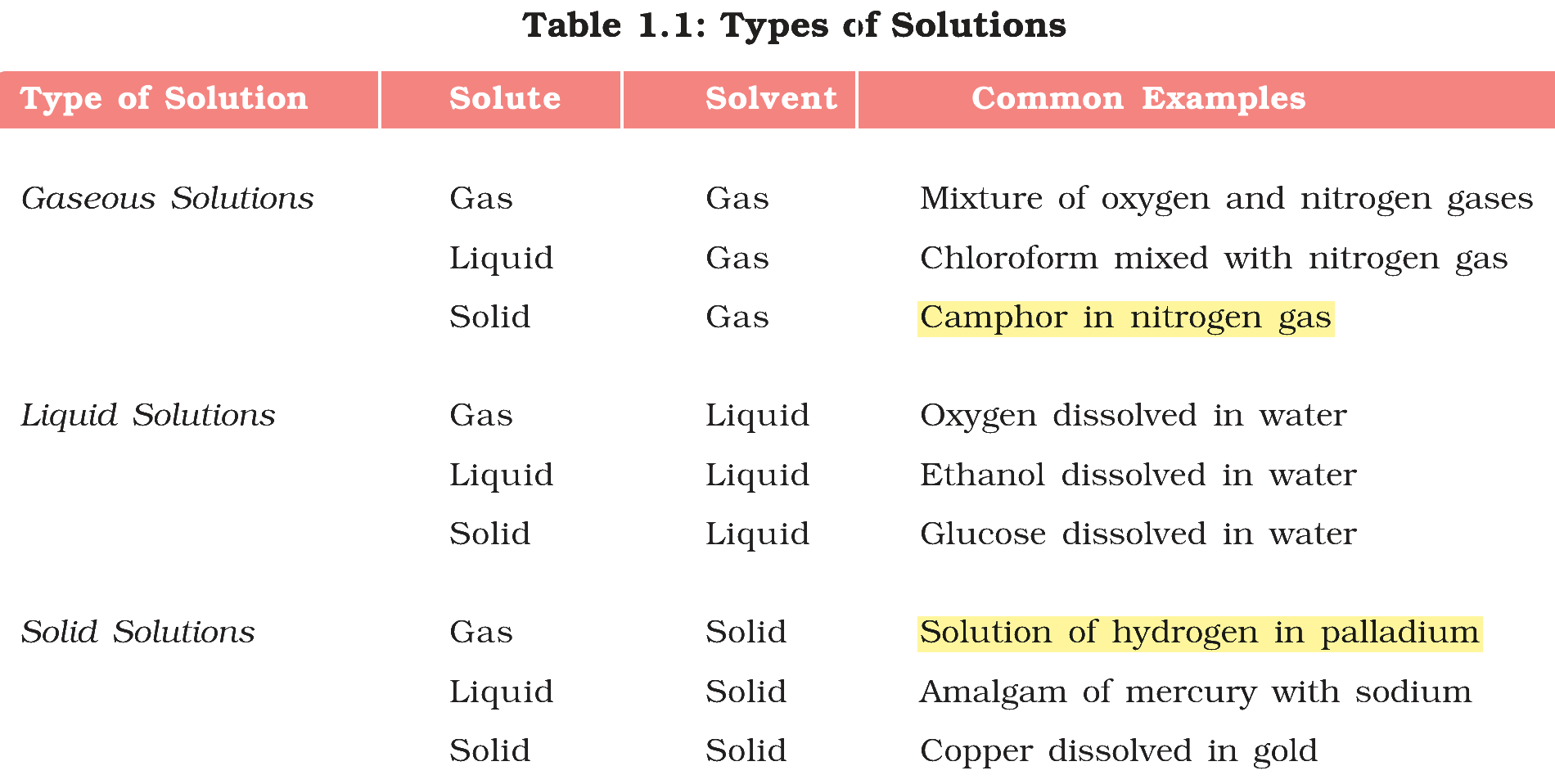
The correct answer is Option (2) → (A)-(II), (B)-(I), (C)-(IV), (D)-(III)
A solution is named by the state of its solute and of its solvent. The solvent, the component in larger amount, decides the state of the solution: a solid solvent gives a solid solution, a gaseous solvent a gaseous solution. In each example below the first substance is the solute and the second the solvent.
(A) solid in solid — This matches (II) Cu in Au. Copper dissolved in gold is an alloy, a solid dissolved in a solid.
(B) solid in gas — This matches (I) Camphor in \( \ce{N2} \). Camphor sublimes, and its vapour mixes with nitrogen gas, giving a gaseous solution of a solid.
(C) gas in solid — This matches (IV) \( \ce{H2} \) in Pd. Palladium metal absorbs hydrogen gas into its lattice.
(D) liquid in solid — This matches (III) Hg in Na. The amalgam of mercury with sodium is a liquid (mercury) dissolved in a solid (sodium).
Shortcut: (B)-(I), camphor in nitrogen, appears only in Option (2).
NCERT (2026-27 edition):
Types of Solutions – …