
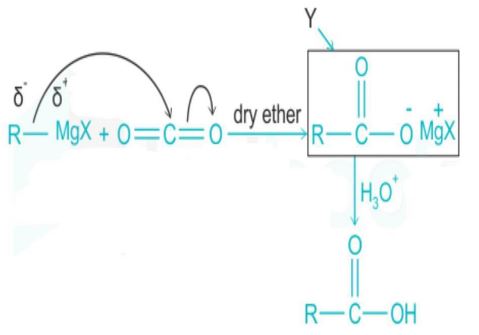
Identify "Y" in the following reaction:

Answer & explanation
Correct answer: option 1
The correct answer is Option (1) → RCOOH
Grignard reagents (R–Mg–X) are highly reactive organometallic compounds that act as strong nucleophiles.
When a Grignard reagent reacts with carbon dioxide (CO₂) in dry ether, the nucleophilic carbon of the Grignard reagent attacks the electrophilic carbon of CO₂ to form a magnesium carboxylate intermediate.
Reaction step:
R–MgX + CO₂ → RCOO⁻MgX
This intermediate is represented as X.
When the reaction mixture is treated with acidic hydrolysis (H₃O⁺), the magnesium salt is protonated to produce a carboxylic acid.
RCOO⁻MgX + H₃O⁺ → RCOOH
Thus, the final product Y is a carboxylic acid (RCOOH).
This reaction is commonly used in organic synthesis to increase the carbon chain length by one carbon atom.
Option-wise Explanation
Option 1: RCOOH
Correct. Grignard reagent reacts with CO₂ followed by acidic hydrolysis to give a carboxylic acid.
Option 2: RCHO
Incorrect. Aldehydes are typically formed when Grignard reagents react with formyl derivatives, not CO₂.
Option 3: RCOX
Incorrect. Acyl halides are not produced in this reaction sequence.
Option 4: ROH
Incorrect. Alcohols are formed when Grignard reagents react with carbonyl compounds such as aldehydes or ketones, not with CO₂.