
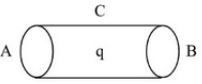
A charge q is enclosed by a hollow cylinder as shown. If the electric flux associated with the curved surface C be $\phi$. The flux through the surface A will be:
Answer & explanation
Correct answer: option 4
The correct answer is Option (4) → $\frac{1}{2}(\frac{q}{ε_0}-\phi)$
By Gauss law,
$\phi_{total}=\frac{q}{ε_0}$
$\phi_{total}=\phi_A+\phi_B+\phi_C=\frac{q}{ε_0}$
$∴2\phi_A+\phi=\frac{q}{ε_0}$
$\phi_A=\frac{1}{2}\left(\frac{q}{ε_0}-\phi\right)$