
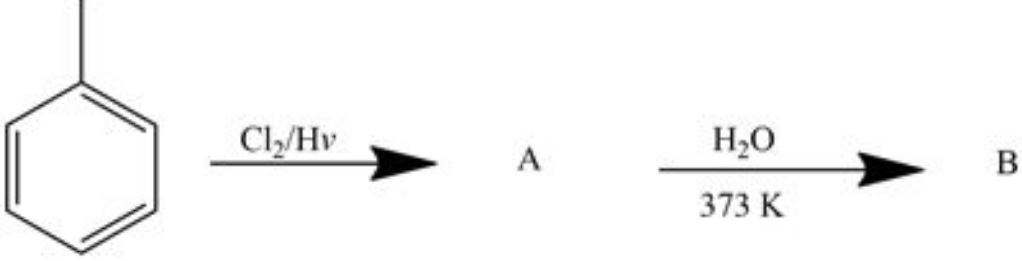
Identify A and B in the following reaction.
Answer & explanation
Correct answer: option 1
The correct answer is Option (1) → A: Benzal Chloride; B: Benzaldehyde
Step-by-Step Reaction Mechanism
1. Step 1: Side-chain Chlorination of Toluene The starting material is Toluene $(C_6H_5CH_3)$. The reagent $Cl_2/hv$ (chlorine in the presence of light) indicates a free radical substitution reaction. In these specific industrial or laboratory conditions, the side chain is chlorinated. To ultimately reach Benzaldehyde in the next step, two hydrogen atoms are replaced by chlorine atoms.
- Result (A): Benzal Chloride $(C_6H_5CHCl_2)$.
2. Step 2: Nucleophilic Substitution (Hydrolysis) The intermediate Benzal Chloride is then reacted with water ($H_2O$) at 373 K (boiling water). The chlorine atoms are replaced by hydroxyl groups ($-OH$), forming an unstable geminal diol ($C_6H_5CH(OH)_2$).
3. Step 3: Elimination of Water Geminal diols are inherently unstable and spontaneously lose a molecule of water ($H_2O$) to form a carbonyl group.
- Final Result (B): Benzaldehyde ($C_6H_5CHO$).
Why the other options are incorrect:
- Benzyl Chloride/Alcohol: This would occur if only one chlorine atom was substituted ($C_6H_5CH_2Cl$).
- o-Chlorotoluene or p-Chlorotoluene: These products would form if the reaction used a Lewis acid catalyst (like $FeCl_3$) instead of light, leading to electrophilic aromatic substitution on the ring rather than the side chain.