
One kind of cake requires 300 g of flour and 15 g of fat, another kind of cake requires 150 g of flour and 30 g of fat. Find the maximum number of cakes which can be made from 7.5 kg of flour and 600 g of fat, assuming that there is no shortage of the other ingredients used in making the cakes. Make it an L.P.P. and solve it graphically.
Answer & explanation
Correct answer: option 3
The correct answer is Option (3) → 30
Let x and y be the number of cakes of first kind and second kind respectively. The problem can be formulated as an L.P.P. as follows:
Maximize $Z = x + y$ subject to the constraints
$300x + 150y ≤ 7500$ (quantity of flour constraint)
i.e. $2x + y ≤ 50$
$15x + 30y ≤ 600$ (quantity of fat constraint)
i.e. $x + 2y ≤ 40$
$x ≥ 0, y ≥ 0$ (non-negativity constraints)
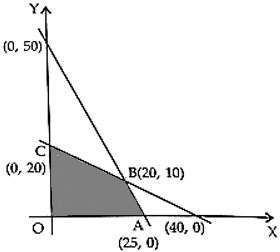
Draw the lines $2x + y = 50$ and $x + 2y = 40$.
Shade the region satisfied by the above inequalities. The feasible region OABC is bounded and convex. The corner points of the feasible region are O(0, 0), A(25, 0), B(20, 10) and C(0, 20). The values of Z at the corner points O, A, B and C are 0, 25, 30 and 20 respectively.
We find that the maximum value of Z occurs at B(20, 10) and maximum value = 30. Hence, the maximum number of cakes is 30 out of which 20 are of first kind and 10 of second kind.