
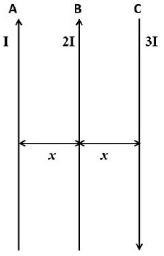
A, B, and C are parallel conductors of equal lengths carrying current I, 2I and 3I respectively, as shown in the figure. $F_1$ is the force exerted by B on A and $F_2$ is the force exerted by C on A. Choose the correct answer
Answer & explanation
Correct answer: option 4
The correct answer is Option (4) → $\vec{F_1}=-1.33\vec{F_2}$
$\text{For two long parallel wires: } \frac{F}{L}=\frac{\mu_0}{2\pi}\frac{I_1 I_2}{r} \text{ (attractive for same direction, repulsive for opposite).}$
$\text{Distances: } AB=x,\ AC=2x.\ \ \text{Currents: } I_A=I \ (\uparrow),\ I_B=2I \ (\uparrow),\ I_C=3I \ (\downarrow).$
$\text{Force on A due to B: }\ |\vec F_1|=\frac{\mu_0}{2\pi}\frac{(I)(2I)L}{x}= \frac{2\mu_0 I^2 L}{2\pi x},\ \vec F_1 \text{ toward B (right).}$
$\text{Force on A due to C: }\ |\vec F_2|=\frac{\mu_0}{2\pi}\frac{(I)(3I)L}{2x}= \frac{3\mu_0 I^2 L}{4\pi x},\ \vec F_2 \text{ away from C (left).}$
$\Rightarrow \ \frac{|\vec F_1|}{|\vec F_2|}=\frac{2}{3/2}=\frac{4}{3},\ \text{and directions are opposite.}$
${\ \vec F_1=-\frac{4}{3}\,\vec F_2\ }\quad \Big(\text{equivalently } \vec F_2=-\frac{3}{4}\,\vec F_1\Big)$