
If one of the angles of a triangle is 74°, then the angle between the bisectors of the other two interior angles is :
Answer & explanation
Correct answer: option 3
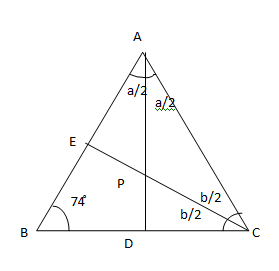
In \(\Delta \)ABC, such that \(\angle\)ACB = \({74}^\circ\) and bisectors \(\angle\)A and \(\angle\)B meet at D and E.
Now, In \(\Delta \)ABC,
\(\angle\)ACB + \(\angle\)ABC + \(\angle\)BAC = \({180}^\circ\)
= \({74}^\circ\) + \(\angle\)ABC + \(\angle\)BAC = \({180}^\circ\)
= \(\angle\)ABC + \(\angle\)BAC = \({180}^\circ\) - \({74}^\circ\) = \({106}^\circ\)
= \(\frac{1}{2}\)(\(\angle\)ABC + \(\angle\)BAC) = \({53}^\circ\)
= \(\angle\)PBA + \(\angle\)BAP = \({53}^\circ\)
Now, In \(\Delta \)PAB,
\(\angle\)PBA + \(\angle\)BAP + \(\angle\)BPA = \({180}^\circ\)
= \({53}^\circ\) + \(\angle\)BPA = \({180}^\circ\)
= \(\angle\)BPA = \({180}^\circ\) - \({53}^\circ\) = \({127}^\circ\)
Therefore, \(\angle\)BPA = \({127}^\circ\).