
CUETMOCK
  • Pricing
  • Mentors
Log inStart freeStart free mocks→

First test, then trust

Try a free CUET mock test.

Join 5,00,000+ students who rehearsed exam day on the exact NTA screen before sitting CUET. On the web and on Android.

Start free mocks →Get the Android app
CUETMOCK

India's #1 CUET Mock Test Platform. Original NCERT-based questions on the exact NTA exam screen — trusted by 5,00,000+ students since CUET 2022.

Get it onGoogle PlayScan to download the CUETMOCK app

Mock tests

  • CUET mock test series
  • Browse all papers
  • Commerce mocks
  • Humanities (Arts) mocks
  • Science mocks
  • Languages & GAT mocks
  • Free practice questions
  • Pricing

Resources

  • CUET exam guide
  • CUET syllabus
  • Universities accepting CUET
  • Expert blogs
  • News & notifications
  • Webinars & counselling
  • CUET score calculator
  • How we estimate your rank
  • FAQs

Company

  • About us
  • Our leadership & team
  • Our toppers
  • Mentors
  • For schools
  • Contact us
  • Terms
  • Privacy
  • Refund policy

Talk to us

+91 7696 6630 56info@cuetmock.comWhatsApp us

Our other platforms

  • JEE Mock — For IIT-JEE aspirants
  • NEET Mock — For NEET aspirants

Newsletter

Exam updates, study material and offers — no spam.

© 2026 NYC Ventures Pvt. Ltd.

701-702, Royal Business Park, Zirakpur, Punjab - 140603

  • Terms of use
  • Privacy policy
  • Refund policy
  • Contact us

iCUETMOCK is an independent preparation platform, not affiliated with the National Testing Agency (NTA). Always check exam details on the official NTA website.

  • Home
  • Mock tests
  • CUET guide
  • Pricing
  • Log in
Home/Practice questions/Physics
PhysicsRay Optics

A converging lens which has a focal length of 20 cm is placed 60 cm t…

A converging lens which has a focal length of 20 cm is placed 60 cm to the left of a concave mirror of focal length 30 cm. An object is placed 40 cm to the left of lens. The position of the final image is:

Answer & explanation+

Correct answer: option 3

For refraction through the lens

u = −40 cm, f = + 20 cm

Lens equation is : $\frac{1}{v}-\frac{1}{u}=\frac{1}{f}$ or $\frac{1}{v}-\frac{1}{-40}=\frac{1}{20}$ or $\frac{1}{v}=\frac{1}{20}-\frac{1}{40}$

or v = +40 cm

This gives the position of image $I_1$. Image $I_1$ will be a real inverted image formed at 40 cm to the right of the lens. As concave mirror is placed to the right of lens at 60 cm, hence the image $I_1$ is at a distance of 20 cm from the mirror. Therefore, image $I_1$ becomes a real object for the concave mirror. 
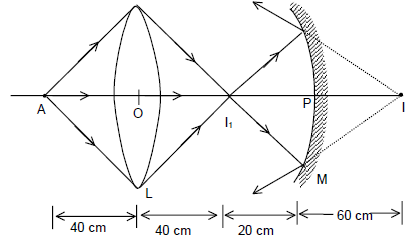
For reflection by concave mirror :

The position of the object $I_1$ is within the focal length of the concave mirror

Here, u = −20 cm, f = −30 cm

Mirror formula is : $\frac{1}{v}+\frac{1}{u}=\frac{1}{f}$ or $\frac{1}{v}-\frac{1}{20}=-\frac{1}{30}$

or $\frac{1}{v}=\frac{1}{20}-\frac{1}{30}=\frac{1}{60}$ or v = +60 cm

This gives the position of final image I.

Advertisement

Practise more on Ray Optics

Chapter-wise mocks on the real NTA exam screen, with solutions and your rank. Your first mocks are free.

Start free mocks →

Advertisement

Next questions

  1. When did the opinion of the narrator about the ship change?English · Comprehension - (Narrative / Factual)
  2. Arrange the following in increasing order of their osmotic pressure generation at 298 K :(The cell wall is permeable to water and not to th…Chemistry · Physical: Solutions
  3. The rate of a chemical reaction doubled for every 10 °C rise in temperature. If the temperature is raised by 50 °C, the rate of reaction wi…Chemistry · Physical: Chemical Kinetics
  4. Who gave the political strategy called 'Non-Congressism'?Political Science · Politics in India Since Independence: Challenges to and Restoration of the Congress System
  5. Identify the start codon from the following:Biology · Molecular Basis of Inheritance
  6. The radius of the shortest orbit in a one-electron system is 0.18 Å for:(Given Bohr's orbit radius = 0.54 Å)Physics · Atoms
  7. Select the option in which the numbers shares the same relationship in set as that shared by the numbers in the given set. (NOTE: Operation…General Aptitude Test · Verbal Reasoning
  8. Which of the following is not a solvency ratio?Business Studies · Controlling
  9. In many early Buddhist sculptures, the wheel was a frequently used symbol. What did it stand for?History · Ancient India: Thinkers, Beliefs and Buildings
  10. Four pairs of numbers have been given, out of which three are alike in some manner, while one is different. Choose out the odd one.General Aptitude Test · General Ability