A shift in the budget line, when prices are constant, is due to.
Answer & explanation
Correct answer: option 2
The correct answer is Option (2) → Change in the income of the consumer.
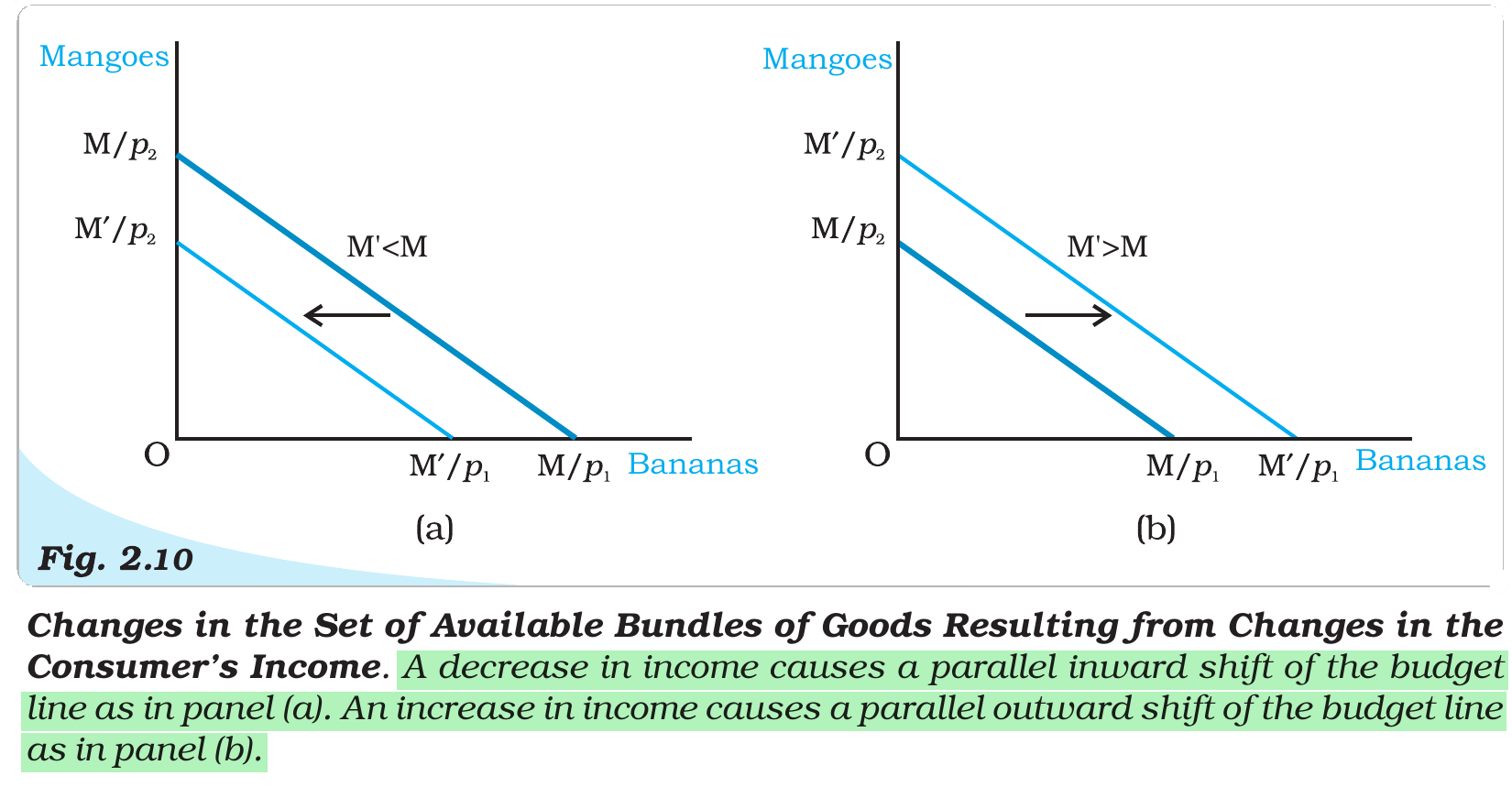
The budget line shows all the bundles of two goods that cost the whole of the consumer’s income. With prices constant, it can shift only when income changes.
If income rises, the consumer can buy more of both goods, so the line makes a parallel outward shift. If income falls, it makes a parallel inward shift. Demand, preferences and utility bear on which bundle she chooses, while the budget line shows only what she can afford.
NCERT (2026-27): “2.2.2 Changes in the Budget Set The set of available bundles depends on the prices of the two goods and the income of the consumer. When the price of either of the goods or the consumer’s income changes, the set of available bundles is also likely to change. Suppose the consumer’s income changes from M to M′ but the prices of the two goods remain unchanged.… …Note that the slope of the new budget line is the same as the slope of the budget line prior to the change in the consumer’s income. However, the vertical intercept has changed after the change in income. If there is an increase in the income, i.e. if M' > M, the vertical as well as horizontal intercepts increase, there is a parallel outward shift of the budget line. If the income increases, the consumer can buy more of the goods at the prevailing market prices. Similarly, if the income goes down, i.e. if M' < M, both intercepts decrease, and hence, there is a parallel inward shift of the budget line. If income goes down, the availability of goods goes down.”
|