Match List-I with List-II
|
List-I Reaction |
List-II Preparation |
|
(A) Kolbe's Reaction |
(I) Salicylaldehyde |
|
(B) Reimer-Tiemann Reaction |
(II) Salicylic acid |
|
(C) Williamson synthesis |
(III) Ethyl methyl ether |
|
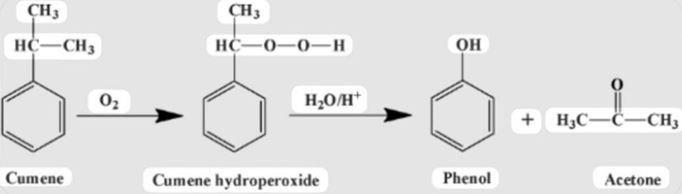
(D) Cumene Process |
(IV) Phenol |
Choose the correct answer from the options given below:
Answer & explanation
Correct answer: option 2
The correct answer is Option (2) → (A)-(II), (B)-(I), (C)-(III), (D)-(IV)
|
List-I Reaction |
List-II Preparation |
|
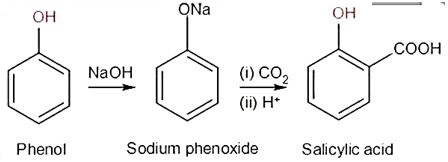
(A) Kolbe's Reaction |
(II) Salicylic acid |
|
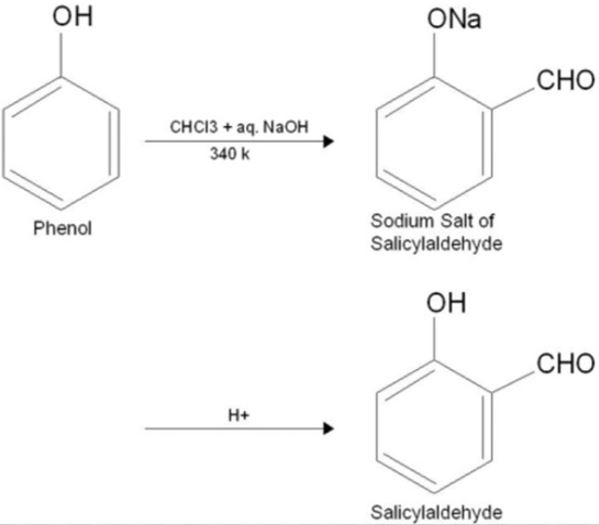
(B) Reimer-Tiemann Reaction |
(I) Salicylaldehyde |
|
(C) Williamson synthesis |
(III) Ethyl methyl ether |
|
(D) Cumene Process |
(IV) Phenol |
(A) Kolbe's Reaction → (II) Salicylic acid
Also called Kolbe-Schmitt reaction. Sodium phenoxide reacts with $CO_2$ under pressure to introduce a $-COOH$ group ortho to $-OH$, forming salicylic acid.
(B) Reimer-Tiemann Reaction → (I) Salicylaldehyde
Phenol treated with $CHCl_3$ and $NaOH$ forms $-CHO$ group at the ortho position via dichlorocarbene intermediate.
(C) Williamson Synthesis → (III) Ethyl methyl ether
Alkoxide ion reacts with an alkyl halide (SN2 reaction) to form ethers like $CH_3-O-C_2H_5$.

(D) Cumene Process → (IV) Phenol
Oxidation of cumene (isopropylbenzene) followed by acid cleavage of cumene hydroperoxide yields phenol and acetone.