Which of the following statements is/are true?
Statement I: When decrease in demand is more than decrease in supply, the leftward shift in the supply curve will be more than the leftward shift in the demand curve.
Statement II: When decrease in demand is more than decrease in supply, price increases and quantity remains constant.
Answer & explanation
Correct answer: option 2
The correct answer is Option (2) → Both the statements are false.
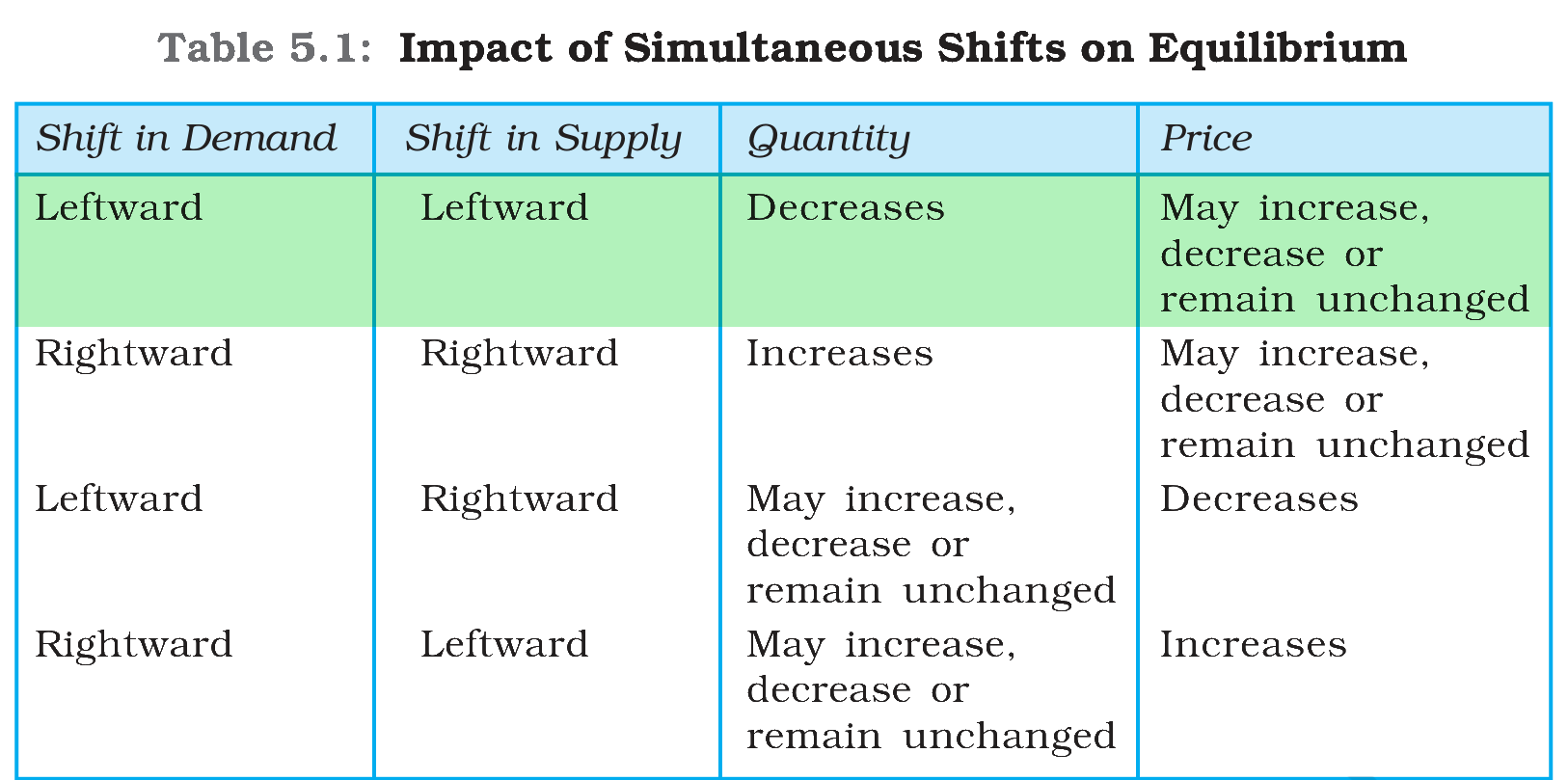
When demand and supply both shift left, the quantity always falls. The price moves the way of the bigger shift; here demand falls more, so the price falls.
Statement I: When decrease in demand is more than decrease in supply, the leftward shift in the supply curve will be more than the leftward shift in the demand curve. — False. Demand falls more, so the demand curve moves further left than the supply curve.
Statement II: When decrease in demand is more than decrease in supply, price increases and quantity remains constant. — False. At the old price there is now excess supply, so the price falls. The quantity also falls; it does not stay the same.
Note: NTA uses the terms ‘decrease in demand’ and ‘decrease in supply’; NCERT describes these as leftward shifts of the demand curve and the supply curve.
NCERT (2026-27): “Simultaneous Shifts of Demand and Supply … In the first two cases which are shown in the first two rows of the table, the impact on equilibrium quantity is unambiguous but the equilibrium price may change, if at all, in either direction depending on the magnitudes of shifts. In the next two cases, shown in the last two rows of the table, the effect on price is unambiguous whereas effect on quantity depends on the magnitude of shifts in the two curves.”
|